


The MBA program offers a personal academic approach to help mature students to prepare for a rapidly evolving business world. The MBA program is elaborately tailored to meet the needs and interests of graduates as they build on their current base of knowledge and work experience. Student understanding are enhanced through the personal attention of highly qualified faculty of the American University in the Emirates.
Surveys from business alumni suggest that this teaching approach has a significant impact on professional development. The primary benefit of the program is geared to prepare students for a lifetime professional development.
The MBA program has a global perspective reflecting the position of the United Arab Emirates (UAE) as a hub of international business activities. Moreover, the status of Dubai as a global business city and the center of the world-class financial market, provides ample global opportunities to draw on local resources. Students from diverse nationalities and cultural backgrounds add flavor to the MBA program and learning environment at AUE.
The Research track, along with one course in the same area, shall provide students with the opportunity to specialize in the respective area of specialization chosen by the student to write the thesis, under the broader umbrella of business administration.
American University in the Emirates has been recognized as a Project Management Institute (PMI) Registered Education Provider (R.E.P). This recognition allows the College of Business Administration to equalize all offered Project Management courses at undergraduate and graduate level to attending certificate preparation course in PMP. With recognition as PMI Registered Education Provider (R.E.P.), AUE is now amongst the premier comprehensive continuing education program providers related to the field of project management.
The mission of the Program is to prepare students for the challenges and opportunities of the information management era, which they will face as knowledge management professionals. Students will be taught and trained in the latest trends in knowledge management. This is done by equipping the students with the necessary skills, research capability and ethics, which can provide excellent services and solutions to the community. In addition, the program is a unique graduate program that can further assist students to pursue their higher education.
The MBA will be specialized based on the thesis topic | extra letter will be provided.


| Course Category | Total Number of Courses | Total Number of Credit Hours |
|---|---|---|
| Bridging Courses | 5 | 10 |
| Core Courses | 7 | 21 |
| Elective Courses | 2 | 6 |
| Thesis | 2 | 6 |
| Total (Excluding Bridging Courses) | 33 Credit Hours |
| Course Name | Course Code | Credit Hours | Course Description |
|---|---|---|---|
| Accounting for Managers | ACC 500 | 2 | This preparatory course introduces the accounting concepts necessary for decision making as it is the core of efficient management processes that heavily depends upon useful accounting information. This course covers accounting and financial information that can help managers to measure and assess performance as well as assist with operational planning within the organization and choose between cost effective alternatives. |
| Management and Organizational Behavior | MGT 500 | 2 | The course examines management functions and theories and analysis the implications of organizational behavior on the process of management. Students will be able to understand and assess behavior of individuals and groups in both culturally diverse and non-diverse organizational setting. The course will help in challenging students to think critically and evaluate the effects that an external environment has on organizational process and behavior. Moreover, students will analyze the elements of organizational structure and the impact that they have on employees. The course covers topics such as: theories and functions of management, organizational culture and structure, employees’ motivation, communication in organizations, stress and conflict management, leadership, team work, job satisfaction, etc. |
| Marketing Concepts | MKT 500 | 2 | Course constitutes a preparatory course for MBA students and provides them with fundamental knowledge of marketing. This course will familiarize students with the scope, terminology, topics, and procedures of marketing strategy and importance of consumer. Students will discuss marketing concepts like product planning strategy, pricing, advertising and distribution from a business perspective. |
| Production and Operations Management | MGT 501 | 2 | The course is designed for students to understand the analytic methods in operation of organizations and industries. The course aims to familiarize the issues facing the operations of organization, production scheduling, capacity and Location planning, process selection, facility layout, inventory control, project management, and quality control to gain competitive advantage in an organization. |
| Statistics and Quantitative Analysis | SQA 500 | 2 | This course is designed to provide students with an understanding of quantitative data and its relevance in business. This course also aims to develop an understanding of quantitative analysis and statistical techniques. This course requires a fundamental understanding of basic statistics like frequency distribution, averages, measures of variability, and probability. The course also recommends a prior understanding of the software application SPSS. The course covers statistical concepts and methods including descriptive statistics, hypothesis testing, correlation analysis, regression analysis, t-test, and ANOVA. |
| Course Name | Course Code | Credit Hours | Course Description |
|---|---|---|---|
| Advanced Financial Management | FIN 600 | 3 | This course is intended to equip students with advanced knowledge of corporate finance by linking theory and application. The students should be able to understand and apply the practical application of financial theory, concepts, and relationships, to review and prioritize concepts in economics, marketing, and resource management, essential in value creation. Additionally, they should analyze different concepts, theories, application and issues related to managerial finance, techniques of analysis, and most importantly, making decisions and managing to create value. Finally, students should develop knowledge in corporate governance issues such as corporate control, bankruptcy, liquidation, and reorganization. |
| Business Research Methods | RMT 600 | 3 | This course offers an introduction to quantitative and qualitative designs in management research as well as to applied statistical methods. The students will learn the language and terminology of business research, research process, usage of data sources and statistical techniques, measurement issues such as reliability and validity, and research instruments including questionnaires and interviews. It will prepare students for conducting a comprehensive research study, from formulating research objectives, questions, problem statements, hypotheses in addition to reviewing the literature, opting for a research approach and analytical/statistical models appropriate for analysis and answering the questions. The course has an applied orientation and students will develop research skills and knowledge to effectively use research findings in decision-making and solving organizational problems. The students will be trained in the use of SPSS and NVivo software programs and will learn how to apply SPSS-based statistical methods in their quantitative studies and NVivo in qualitative research projects. |
| Leadership and Change Management | MGT 601 | 3 | This course examines the importance of leadership in organizations and change management and explains the role of leaders in times of change. The course objective is to provide a balance of theory and practice as it analyses the major leadership theories and change management in regional and international organizations. This course will also help in challenging students to think critically and to make decisions by considering the causes and nature of change, cultural and political contexts for change and how to lead change and designing, planning and implementing change in organization |
| Management of Information Technology | MGT 602 | 3 | The course discusses the information systems planning, organizing and the application of information technology advancements. This course has a managerial perspective that describes how IS / IT supports business goals and functions that are applicable to management, what information resources are available to the manager, and how the manager is involved in the information development process. |
| Managing Human Resources | HRM 600 | 3 | Human Resource Management links people-related activities to business strategy. The course develops a critical understanding of the role and functions of the various human resource activities in an organization, providing students with a comprehensive review of key HRM concepts, techniques and issues. Topics include Planning for people, HR in a globally competitive business, HR technology, People analytics, Regulatory context of HRM, , Recruitment and selection, Training and development, Performance management, Compensation and rewards, , Managing Conflict and Negotiation, Procedural justice and ethics in employee relations, and Internationalization of HR management. |
| Marketing and International Business | MKT 600 | 3 | The Marketing and International Business course is designed to expose the students to the trends and practices in the dynamic international business environment. The globalization of markets and production, followed by the increase of free trade in the modern world, has had an apparent effect on the international business activities of many countries, including marketing activities. As a result, many business activities are becoming global in recent years. The course content will cover the impact of globalization, international trade agreements, cultural differences, global marketing, foreign exchange markets, political environments, and international business strategies, emphasizing applying marketing processes in the international environment. |
| Strategic Management : Theory and Practice | MGT 600 | 3 | The Strategic Management course is the capstone course in the MBA Program, which integrates the knowledge from different business disciplines such as Economics, Financial Management, Marketing International Business, and Information Technology. The course helps students gain the knowledge necessary to successfully manage organizations in a highly complex business environment. It further helps them understanding, developing, and implementing the advanced strategic management models to analyze organizational internal and external environments. It advances students’ knowledge, skills, and competencies needed to design effective strategies for global business. |
| Course Name | Course Code | Credit Hours | Course Description |
|---|---|---|---|
| Thesis 1 | MGT 610 | 3 | This course is the first course in a series of two courses, taken in consecutive semesters. Students in this course will work with their thesis supervisor to develop a thesis proposal and begin their distinctive, applied research project. The primary goal is for the student to practice the mechanisms of transitioning from concept to active inquiry. Depending on the nature of the topic, the student will develop a study questions, conduct a tentative literature review, develop a methodological approach, and begin preliminary research. Students are expected to apply qualitative, quantitative, and comparative research analysis approaches to the chosen topic. Students will be required to provide the oral defense of Thesis Proposal as part of the assessment and fulfillment of the Thesis 1 course. |
| Thesis 2 | KMI 720 | 3 | In this course, students will continue developing their thesis project, revising techniques (if required), addressing challenges, analyzing findings, and eventually articulating the complete experience. Students will build on work from the previous semester and put all of the pieces together to complete the final thesis project, following the required research process and procedures. The thesis is a work of original scholarship, designed with guidance from a thesis supervisor and thesis committee. Students will be required to provide the oral public defense as part of the assessment and fulfillment of the Thesis course. |
| Course Name | Course Code | Credit Hours | Course Description |
|---|---|---|---|
| Digital Marketing and Social Media | MKT 604 | 3 | This course introduces students to emerging interactive technologies and social media tools, and discusses ways in which these technologies can be exploited by businesses to more effectively serve markets. Students will further examine how marketing-related functions are changed by the potential of new technologies and how these new technologies can become key components of the organization’s strategic marketing effort. Special emphasize is given to analysis of modern digital, tech-savvy connected customers, digital subcultures and engagement and content marketing practices.. |
| Innovation and Entrepreneurship | MGT 604 | 3 | This course marks students’ introduction to the theory and practice of innovation and entrepreneurship. Whether they are creating an opportunity or seizing an existing one students explore the core concepts and tools for creating new products or services, new businesses, or new markets from a multilayered perspective. The course examines the fundamentals of innovation in a multitude of settings, operationalizing the entrepreneurial spirit via a comprehensive business plan, and making decisions in the areas of strategic planning, financing, marketing, process improvement, and management with an awareness of the opportunities and challenges of working in an increasingly complex environment regionally and internationally. |
| Islamic Economics and Finance | FIN 601 | 3 | This course provides a comprehensive study of the Islamic Economics and Finance. It focuses on the Islamic economic philosophies underlying the Islamic economic system and its implications for the tools of fiscal and monetary policy. Economic fairness, market functionality & efficiency, and equity are examined from an Islamic vantage point. The course further discusses both theory Islamic economics and finance with its application for designing instrument of finance and Islamic financial institutions. Important topics of the course includes: The Nature and Significance of Islamic Economics, Scarcity Self-interest and Maximization, Islam and Economic Development, Growth Versus Environment, Distributive Justice, Micro Foundations and Macro Modelling, Deficit Financing in Developing Countries, Money: Evolution, Forms, and Expansion, Credit Creation and Control, The Basel Accords and Islamic Banks, Systems’ Convergence, Correction of a Misconception, Home Financing Models, Methodology and Islamic Economics, and Issues in Profit Measurement |
| Managerial Economics | ECO 600 | 3 | This course is designed to enhance the understanding of managerial economics concepts and quantitative tools used in decision making. Topics to be covered in the course include managerial decision making, demand and supply, individual behaviour, production process and costs, organization of firms, industry nature, competitive and monopolistic markets, and pricing strategies. Furthermore, the course covers the changing structure of organizations and the strategic behaviour of managers in today's complex and continuously changing business environment. |
| Organizational Culture and Impacting Change | KMI 605 | 3 | In this course, we delve into the complexities of digital transformation, revealing how it impacts organizations and why success is not guaranteed. You'll learn about the crucial elements that shape successful transformations and the need for a systematic approach that goes beyond individual initiatives. Through a focused analysis of established strategies, we pinpoint ten critical areas that can make or break a digital transformation, including vision, leadership, communication, digital culture, and more. Drawing from real-world insights, we propose a structured framework that forms the basis for effective digital transformation management. Student will explore the details of digital transformation in this advanced course which is designed to equip you with a comprehensive understanding of successful implementation strategies. Grounded in a systematic approach and drawing inspiration from the analysis of prominent management models, this course goes beyond the basics to delve into the nuanced aspects of digital transformation. |
| Project Management | MGT 606 | 3 | This course is designed to provide an overview of main concepts, models, project management tools, techniques, and challenges associated with planning and managing projects. This course equips the students with the required knowledge in different related topics like Project Selection, Scope Management, Project Team Building, Risk Management, Cost estimation and Budgeting, Project Scheduling, Project Evaluation and Control, Resource Management. All the covered topics are aligned with PMBOK, and the student will experience his practical skills through MS Project. |
| Seminar in Contemporary Topics in Management | MGT 608 | 3 | The primary objective of this course is to acquaint students with the most recent business practices, trends, and challenges within various business disciplines. Specific contemporary/ emerging topics from different areas of management covered in the outline includes managers and business, business research techniques, happiness in organizations, Green HRM and talent retention, ethics and social responsibility, organizational excellence, decision-making in teams, virtual and distributed teams, artificial intelligence in current and future business practices, automation and robotics, artificial intelligence application in industries, blockchain and bitcoin, neuromarketing and application of new technologies, design thinking and lean startup, and smart city management etc. This will provide students with an opportunity to explore cutting-edge developments in different management areas, and to choose the topics most relevant to their field of interest. The course will explore current topics with a special emphasize on contemporary business and management practices and challenges from MENA region. |
| Strategic Cost and Managerial Accounting | ACC 600 | 3 | This course provides a comprehensive graduate level exploration of strategic cost and managerial accounting. It focuses on the use of accounting data in the management of an organization. The major contents covered in the course include cost management and strategy, value chain, balanced scorecard, strategy map, basic cost management concepts, job costing, activity-based costing, customer profitability analysis, process costing, cost allocation, cost estimation, short-term profit planning: cost-volume-profit (CVP) analysis, master budget, decision making with a strategic emphasis, analysis capital investments, cost planning for the product life cycle, target costing, theory of constraints, strategic pricing, and operational performance measurement. It will enable students to understand why accounting data are interesting and how they might by the managers to obtain the desired outcome. |
| Supply Chain Management | SCM 600 | 3 | This course addresses supply chain management in contemporary business organizations. The focus is the strategic and operational issues that drive management decisions on the design and implementation frameworks in use in modern supply chain management. Innovative approaches to managing supply chain value boundaries and the impact of the international global supply chains on UAE's business environment are also discussed. |
| Total Quality Management | MGT 615 | 3 | This course is designed to expose students to the various TQM frameworks, philosophies, and quality improvement basic and advanced tools necessary for implementing the quality culture that characterizes world-class organizations of the 21st century. The course is built around the core values and the criteria for performance excellence embodied in the national as well as International Quality Award. Furthermore, the course explores these key actions necessary for implementation of continuous and never-ending improvement philosophy and business excellence models allowing organizations to effectively deliver value to their customers, clients, and constituents. |
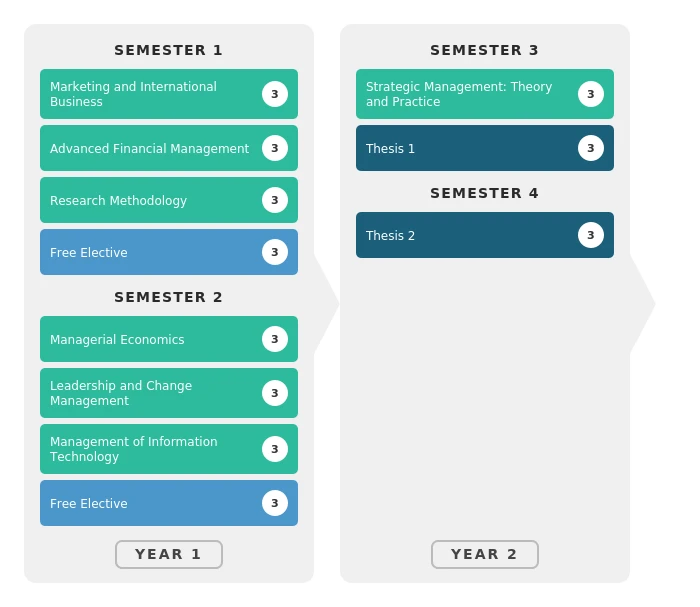
For graduate degree completion, graduate students must satisfy the following requirements:
1. Earn a minimum CGPA of 2.00 on a scale of 4.00.
2. Successfully complete all courses as described in the study plan.
3. The Degree Completion requirements must be met within the timeframe of the program.
4. Successfully complete the "Thesis" course.
Please Click Here to know more
Graduates of the MBA program are equipped for leadership and management roles across a wide range of industries. The program’s global perspective and practical approach prepare students to thrive in corporate, entrepreneurial, and government settings.
Career paths include positions such as Business Consultant, Marketing Manager, Financial Analyst, Human Resources Manager, Operations Manager, Project Manager, Investment Advisor, Strategy Analyst, Entrepreneur, and Executive Director. Graduates also gain the analytical and leadership skills necessary to advance into C-suite roles or pursue further academic research and teaching opportunities.
| Name | Designation | Organization |
|---|---|---|
| Dr. Shuja Ali | Chief Investment Officer | Saham Investment Management PJSC |
| Ms. Kholood Abdullah Al Awadhi | Head of Academic Affairs (COBA Alumni) | UAE Ministry of Education |
| Mr. Ratko Kupresak | Country Director | Aujan Coca Cola |
| Ms. Aisha Saleh Al Zarouni | Public relations/social responsibility Deptt. (COBA Alumni) | Sharjah Chamber of Commerce & Industry |
| Meshal Al Kahtani | TV presenter / manager of news deptt. (COBA Alumni) | Dubai Sport channel |
| Dr. Nihal El Daly | CEO | Axellerus Consultants |
| Dr. Mehmet Tosun | Director of the Ozmen Center for Entrepreneurship | University of Nevada |
| Dr. Ivan Pribicevic | CEO Simplify Consulting | Simplify Consulting |
| Dr. Samir Moussalli | International Professor of Business | Auburn University, USA |
| Dr. Mohaymen Abdulghani | CEO | Fakeeh Hospital |
| Mr. Imad Eddine OUBIRI | International Relations Strategist, Sr. Business Anchor | AIM Congress |
| Mr. Abdulla Alhussam | CEO | CLA Tourism |
| Dr. Eng. Mateusz Tomanek | Assistant Professor | Nicolaus Copernicus University in Toruń |
| Mr. Ron Young | CEO & CKO | Knowledge Associates Cambridge Ltd |


