

The AUE has developed a strong and comprehensive Master of Sports Management (MSM) Program providing guidance and leadership to the sports sector across the UAE and the GCC region. The program develops and enhances management, sport and business skills to effectively govern sport-related organizations. The programs prepare students to become tomorrow’s leaders in delivering state-of-the-art decisions and strategic orientation in the sports industry.
The MSM program is built for advanced students to expand their skills and competencies for the dynamic world of sport. That said, the program is structured to enable students to pursue further academic and professional development. The strategic approach of the AUE is to place the MSM program as a leading program for studies on sport-related industry serving as a hub for delivering education, consulting and extensive network.
The program is focused on developing, integrating and delivering a contemporary knowledge and understanding of sport-related and business science. Students are coming from diverse backgrounds enriching the program with their know-how, experience and culture.


| Course Category | Total Number of Courses | Total Number of Credit Hours |
|---|---|---|
| Bridging Courses | 5 | 10 |
| Core Courses | 7 | 21 |
| Elective Courses | 2 | 6 |
| Thesis | 2 | 6 |
| Total (Excluding Bridging Courses) | 33 Credit Hours |
| Course Name | Course Code | Credit Hours | Course Description |
|---|---|---|---|
| Accounting for Managers | ACC 500 | 2 | This preparatory course introduces the accounting concepts necessary for decision making as it is the core of efficient management processes that heavily depends upon useful accounting information. This course covers accounting and financial information that can help managers to measure and assess performance as well as assist with operational planning within the organization and choose between cost effective alternatives. |
| Management and Organizational Behavior | MGT 500 | 2 | The course examines management functions and theories and analysis the implications of organizational behavior on the process of management. Students will be able to understand and assess behavior of individuals and groups in both culturally diverse and non-diverse organizational setting. The course will help in challenging students to think critically and evaluate the effects that an external environment has on organizational process and behavior. Moreover, students will analyze the elements of organizational structure and the impact that they have on employees. The course covers topics such as: theories and functions of management, organizational culture and structure, employees’ motivation, communication in organizations, stress and conflict management, leadership, team work, job satisfaction, etc. |
| Marketing Concepts | MKT 500 | 2 | Course constitutes a preparatory course for MBA students and provides them with fundamental knowledge of marketing. This course will familiarize students with the scope, terminology, topics, and procedures of marketing strategy and importance of consumer. Students will discuss marketing concepts like product planning strategy, pricing, advertising and distribution from a business perspective. |
| Production and Operations Management | MGT 501 | 2 | The course is designed for students to understand the analytic methods in operation of organizations and industries. The course aims to familiarize the issues facing the operations of organization, production scheduling, capacity and Location planning, process selection, facility layout, inventory control, project management, and quality control to gain competitive advantage in an organization. |
| Statistics and Quantitative Analysis | SQA 500 | 2 | This course is designed to provide students with an understanding of quantitative data and its relevance in business. This course also aims to develop an understanding of quantitative analysis and statistical techniques. This course requires a fundamental understanding of basic statistics like frequency distribution, averages, measures of variability, and probability. The course also recommends a prior understanding of the software application SPSS. The course covers statistical concepts and methods including descriptive statistics, hypothesis testing, correlation analysis, regression analysis, t-test, and ANOVA. |
| Course Name | Course Code | Credit Hours | Course Description |
|---|---|---|---|
| Business Research Methods | RMT 600 | 3 | This course offers an introduction to quantitative and qualitative designs in management research as well as to applied statistical methods. The students will learn the language and terminology of business research, research process, usage of data sources and statistical techniques, measurement issues such as reliability and validity, and research instruments including questionnaires and interviews. It will prepare students for conducting a comprehensive research study, from formulating research objectives, questions, problem statements, hypotheses in addition to reviewing the literature, opting for a research approach and analytical/statistical models appropriate for analysis and answering the questions. The course has an applied orientation and students will develop research skills and knowledge to effectively use research findings in decision-making and solving organizational problems. The students will be trained in the use of SPSS and NVivo software programs and will learn how to apply SPSS-based statistical methods in their quantitative studies and NVivo in qualitative research projects. |
| Managing Sport | MSM 602 | 3 | This course provides the basic concept of sports management in terms of its scope, principles, issues and future trends. Additionally, it provides an opportunity to explore sport managers’ role, responsibilities, and required skills in organizations in the sport industry and to learn strategies for their career sucess. This course includes the methods how to communicaticate with business-related analytics and how to interpret data for making appropriate decisions. It provides students with the opportunity to gain information and understanding of the various practices and procedures associated with sport administration and management. |
| Sport Facilities and Events Management | MSM 604 | 3 | This course examines fundamental skills necessary to manage different kinds of sport facilities and events and then extends that knowledge into the challenges of managing sport facilities and events. The course focuses on fundamentals of facility operations including programming, maintenance scheduling, risk management, environmental management and impact assessment. The latter part of the course builds on the facility management material by examining the ways that events fit into scheduling for facility use. |
| Sport Finance | MSM 603 | 3 | This course examines the key financial skills necessary to manage sport organizations in both public and private settings. Emphasis will be placed on the different financial attributes of sport industry segment including recreational, amateur, and professional sports. It will also provide the students with an opportunity to explain the various financial challenges facing the sports industry and critically analyze several components. The goal of this course is to enable the students to evaluate and to solve problems involving sports financing and to effectively communicate their recommendations to others. |
| Sport Governance and Policy | MSM 600 | 3 | The course explains the sport governing and policymaking bodies in detail including recreational sport, amateur athletics, Olympic and professional sport. The course highlights the sport governance and policymaking processes in GCC countries. |
| Sport Marketing | MSM 601 | 3 | This course examines the application of basic principles of business marketing to diverse sectors in the sport industry. The course explores the basics of sport market segments (spectators and participants) and builds on that to identify principles for creating and maintaining deep relationships with the sport consumer. It also explores marketing operations for sport including database marketing, customer relations, and brand and line extensions in sport. It presents the basics of sponsorship, including the sponsor-sport property partnership, activating sponsorships, and assessing sponsorship effectiveness. |
| Sports Law and Ethics | MSM 605 | 3 | This course is designed to provide an extensive overview of legal principles and ethical issues that apply to the sport industry and that impact the work setting of sport organizations. It begins with an introduction to the different fields of law and the broad issues related to sports law. The course also covers the role and application of ethics in the decision-making process. |
| Course Name | Course Code | Credit Hours | Course Description |
|---|---|---|---|
| Thesis 1 | MSM 620 | 3 | Students in this course will work with their thesis supervisor to develop a thesis proposal and begin their distinctive, applied research project. The primary goal is for the student to practice the mechanisms of transitioning from concept to active inquiry. Depending on the nature of the topic, the student will develop a study questions, conduct a literature review, develop a methodological approach, and begin preliminary research. Students are expected to apply qualitative, quantitative, and comparative research approaches to the chosen topic. |
| Thesis 2 | MSS 617 | 3 | In this course, students will continue developing their thesis project, revising techniques (if required), addressing challenges, analyzing findings, and eventually articulating the complete experience. Students will build on work from the previous semester and put all of the pieces together to complete the final thesis project, following the required research process and procedures. The thesis is a work of original scholarship, designed with guidance from a thesis supervisor and thesis committee. Students will be required to provide the oral public defense as part of the assessment and fulfillment of the Thesis course. |
| Course Name | Course Code | Credit Hours | Course Description |
|---|---|---|---|
| Internship | MSM 606 | 3 | The course provides students with the opportunity to apply acquired learning in a practical field in addition to extending their learning in a contextualized and practice-based environment. The purpose of the course is the synthesis, extension and practical based application of learned skills by field experience with a sport organization under the supervision of a faculty member to develop knowledge and skills in the application of sport management theory in a non-classroom setting. |
| Special Topics in Sport Management | MSM 614 | 3 | The course content will reflect the interest of the faculty members and current issues in the sport industry such as global challenges, contemporary issues, ethical issues confronting management, management in changing environment and management under crises. Topics will vary annually. |
| Sport Consumer Behavior | MSM 608 | 3 | The course deals with various consumer behavior factors that affect sports and events like consumer motivation, decision making, and how they influence sport marketing activities. It also deals with marketing strategies for sports awareness and attraction. The course also helps in preparing a functional guide to success in planning marketing actions and strategies that promote and deliver sports events. |
| Sports Development Policy | 3 | The course deals with development of Sports and the various policies that govern the sport in the UAE, GCC and international levels. The management of Sports development and the development of Sports as a tool for human development is discussed. Sports development will be examined from a social construct and infrastructure development. The course discusses policies to develop Sports at a regional and international level. |
|
| Sport Globalization | MSM 609 | 3 | The course is designed to provide an overview of the global sport industry including the global sport calendar and key organizations and actors. Managing, marketing, business and financial challenges of coordinating across borders and cultures is a key focus of the course. Additional topics include the localization of international sport and the relationships between sport and culture. |
| Sport Media and Communication | MSM 615 | 3 | This course is designed to provide students with an overview of the sport media communication field. The course presents the sports writing, broadcasting, online media, advertising and video production, and examines the differences between content rooted in journalism and content rooted in organizational communication. The goal of the course is providing students with an opportunity to be exposed to the full range of sport media communication; including locating sport communication within the broader field of sport management and administration; different approaches and languages, lines of communication, personal and organizational aspects of sport communication; the various areas or segments of sport media; the services and support systems associated within sport media communication. |
| Sport Tourism | MSM 611 | 3 | This course is designed to understand an interrelationship between two multi-billion dollars industry of tourism and sports. This course introduces students to the nature, structure, and complexity of the sport tourism industry. It focuses on the nature of tourism and entertainment, its economic aspects, cultural factors, marketing, management and nature of sports. Topics covered include: economic, sociocultural and environmental impacts, motivations, marketing, and development principles. |
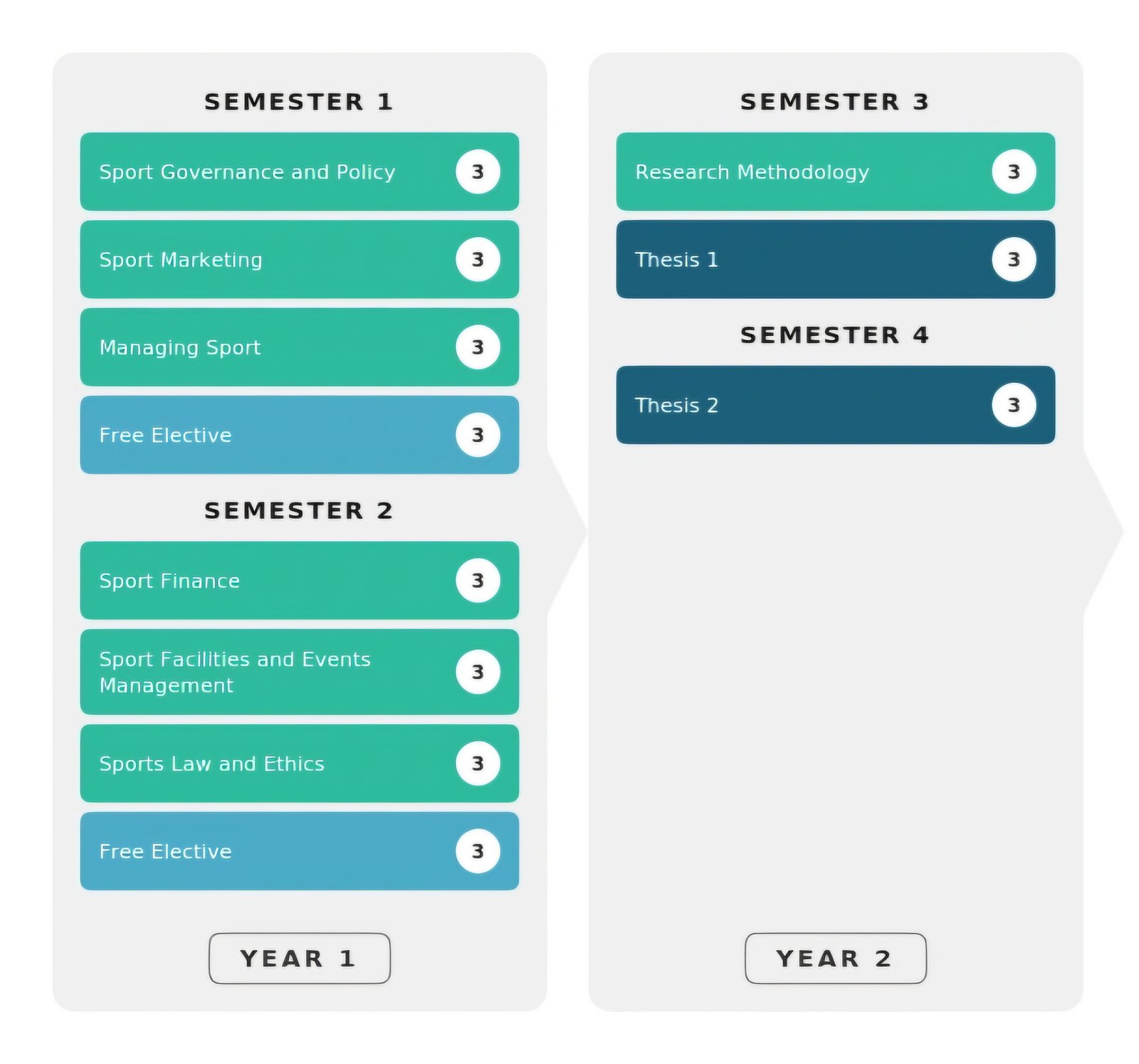
For graduate degree completion, graduate students must satisfy the following requirements:
1.) Earn a minimum CGPA of 2.00 on a scale of 4.00.
2.) Successfully complete all courses as described in the study plan.
3.) The Degree Completion requirements must be met within the timeframe of the program.
4.) Successfully complete the "Thesis" course.
Graduates of the Master of Sports Management program are equipped for diverse leadership roles across the sports industry, including sport clubs, event management, facility operations, marketing, sponsorship, and sports governance. The program prepares students to excel in managing professional and community sports organizations, leading strategic initiatives, and supporting the growing sports sector in the region and beyond.
| Name | Designation | Organization |
|---|---|---|
| Dr. Jane Williams | Head of Research | Hartpury University |
| Mr. Adnan Al Sayadi | IT Manager | UAE equestrian federation |
| Mr. Albert S. Bichi | Executive Director of EPSI | EPSI |
| Mr. Ali Omar Al Balooshi | Director Sports Development | Dubai Sports Council |
| Mr. Paolo Bertaccini Bonoli | Adviser | Italian Ministry of Foreign Affairs |
| Mr. Malek Doughan | Marketing & Commercial Affairs Director | UAE Pro League |
| Mr. Zeljko Banicevic | PhD student, Executive, Director for HERC | HERC |
| Dr. Akram Azmy | Vice President- MEA | Beckman Coulter |
| Ms. Agata Krzywka | Founder | Krzywka Iconic |
| Dr. Leonardo Mataruna | Head of Department of Creative Industries | Canadian University Dubai |
| Mr. Abqulrazzaq Alkabi | General Secretariat Office Manager | UAE, Football Association |
Equestrianism is ever increasing in popularity, the leaders and strategic managers who will shape equestrianism’s future will therefore require an outstanding foundation in both business and equine management to be successful.
Upon completion of the Sports Management program, graduates have the opportunity to possess a specialized concentration in Equine Management to develop professional business skills contextualized to the equestrian environment enabling them to make effective and viable decisions within the broader management of equestrian related businesses.
| Requirements | MSM | |
|---|---|---|
| No. of Courses | Cr. Hrs | |
| Bridging Courses(*) | 5 | 10 |
| Core Courses | 7 | 21 |
| Free Electives | 2 | 6 |
| Thesis 1 | 1 | 3 |
| Thesis 2 | 1 | 3 |
| Equine Management Concentration Courses | 4 | 12 |
| Total (Excluding Bridging Course) | 45 | |
| Course Name | Credit Hours |
|---|---|
| Bloodstock Management | 3 |
| Equestrian Event and Client Management | 3 |
| Performance Analysis in Equestrian Sport | 3 |
| The Global Horseracing Industry | 3 |
| Total | 12 |


