


Lead with Insight. Research with Purpose. Transform with Expertise.
The Doctorate in Business Administration (DBA) at the American University in the Emirates (AUE) is an advanced doctoral program for accomplished executives, senior professionals, and aspiring scholars ready to turn their leadership experience into impactful research and strategic innovation.
Designed for leaders across business, government, and academia, AUE’S DBA provides a dynamic platform to convert deep industry knowledge into scholarly contributions that advance business practice and shape the future of organizations.
This is more than just a degree it’s a launchpad for driving meaningful change. The DBA empowers professionals to influence systems, redefine frameworks, and solve complex business challenges through rigorous, applied research. Focus areas include strategic leadership, financial decision-making, sustainable enterprise, digital transformation, and public-sector innovation, ensuring your research remains relevant and makes a real-world impact.
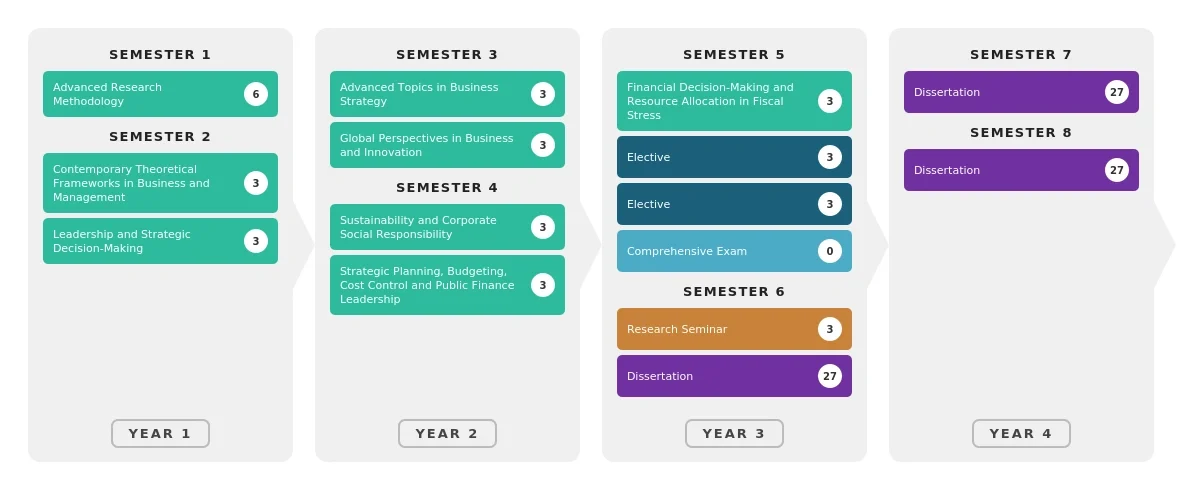
The curriculum guides you from advanced academic foundations to original dissertation research. Candidates engage in doctoral coursework, collaborative research seminars, and dissertation development in high-demand fields such as FinTech, behavioral marketing, entrepreneurship, global strategy, and policy design. This multidisciplinary approach allows you to align your research path with your expertise, passion, and long-term goals.
Delivered entirely on campus, the DBA creates an immersive learning environment where students benefit from direct interaction with distinguished faculty from AUE’s College of Business Administration. Our faculty combines academic excellence with real-world insight, mentoring you to develop advanced research skills, sharp analytical thinking, and the confidence to tackle today’s pressing business and policy issues. Graduates of the DBA program emerge as research-driven leaders-equipped to shape institutional strategy, contribute to academic knowledge, and deliver transformative solutions within their fields of influence.


| Course Category | Total Number of Courses | Total Number of Credit Hours |
|---|---|---|
| Core Courses | 8 | 27 |
| Elective Courses | 2 | 6 |
| Comprehensive Exam | 0 | |
| Research Seminar | 3 | |
| Dissertation | 27 | |
| Total | 63 Credit Hours |
| Course Name | Course Code | Credit Hours | Course Description |
|---|---|---|---|
| Advanced Research Methodology | 3 | Develops expertise in designing and conducting business research using advanced qualitative, quantitative, and mixed-methods approaches. Quantitative Analysis for Business Research - Focuses on statistical techniques, econometrics, and data-driven decision-making in business research. Qualitative Analysis and Mixed Methods Research - Explores case study research, ethnography, and integrating qualitative insights with quantitative analysis. |
|
| Advanced Topics in Business Strategy | DBA 703 | 3 | DBA 703 is an advanced-level course within the Doctor of Business Administration (DBA) program, designed for students who have already acquired foundational knowledge in management and business strategy. It builds upon prior coursework to deepen strategic thinking and decision-making capabilities at the executive level. The course examines cutting-edge frameworks in strategic management, competitive analysis, innovation, and global business dynamics. It equips students to analyze complex environments, evaluate disruptive trends, and design sustainable strategies for business growth and transformation. Key topics include industry analysis, innovation strategies, mergers and acquisitions, digital transformation, CSR and sustainability, and entrepreneurial strategy. This course is intended for DBA candidates, particularly those specializing in strategic management, executive leadership, consulting, or corporate transformation roles. Students will strengthen skills in critical analysis, strategic decision-making, competitive positioning, risk management, and strategic innovation. The course emphasizes the synthesis of theory and practice, culminating in a research-driven strategic business plan that demonstrates real-world application and executive-level insight. The course bridges academic theory and industry practice through case studies, applied projects, and the exploration of contemporary strategic challenges faced by global organizations. It prepares students to lead complex strategic initiatives, navigate disruption, and deliver sustainable value in dynamic business landscapes. |
| Contemporary theoretical Frameworks in Business and Management | 3 | Examines foundational and emerging theories in business administration, providing a conceptual framework for research and practice. |
|
| Financial Decision-Making and Resource Allocation in Fiscal Stress | DBA 707 | 3 | This course explores financial decision-making strategies and resource allocation techniques during periods of fiscal stress. It covers risk assessment models, financial resilience strategies, cost-cutting measures, and crisis management in both the public and private sectors. Students will analyze financial sustainability frameworks and develop strategies to navigate economic downturns effectively. |
| Global Perspectives in Business and Innovation | DBA 704 | 3 | This course investigates international business trends, market dynamics, and innovation strategies in a globalized economy. Students will explore key drivers of globalization, cross-border trade policies, global financial systems, and cultural impacts on business operations. Emphasis is placed on strategic decision-making for international market expansion, managing global supply chains, and fostering innovation to remain competitive in the international arena. |
| Leadership and Strategic Decision-Making | DBA 702 | 3 | This advanced course is a core component of the Doctor of Business Administration (DBA) program, positioned to deepen doctoral candidates’ expertise in organizational leadership and strategic decision-making. It integrates theory with practice, preparing students to navigate complex business landscapes. |
| Strategic Planning, Budgeting, Cost Control, and Public Finance Leadership | DBA 706 | 3 | This course focuses on financial strategy, budgeting techniques, and cost control methods essential for public and private sector leadership. It provides an in-depth exploration of financial planning, resource allocation, performance-based budgeting, and risk assessment. The course also covers fiscal policies, capital investment planning, and public finance leadership, preparing students to manage financial challenges in complex organizational environments. |
| Sustainability and Corporate Social Responsibility | DBA 705 | 3 | This course examines sustainable business practices, ethical decision-making, and corporate social responsibility (CSR) in business leadership. It explores the role of businesses in addressing global sustainability challenges, integrating ethical considerations into decision-making, and developing CSR strategies that create long-term value for organizations and stakeholders. Topics include environmental, social, and governance (ESG) factors, sustainability reporting, stakeholder engagement, and ethical leadership. |
| Course Name | Course Code | Credit Hours | Course Description |
|---|---|---|---|
| Advanced Operations Research | DBA 713 | 3 | This course applies mathematical modeling, optimization techniques, and data analytics to improve business decision-making and operational efficiency. It covers advanced topics in linear programming, simulation, network analysis, and decision science to equip students with the necessary tools for tackling complex business challenges through quantitative methods. The course integrates real-world applications and case studies to enhance problem-solving skills. |
| Behavioral Insights in Marketing | DBA 710 | 3 | This course examines psychological and behavioral principles that influence consumer decision making and marketing strategies. Students will explore cognitive biases, heuristics, social influences, and emotional triggers that shape consumer behavior. The course will integrate theories from behavioral economics and psychology to analyze marketing effectiveness and consumer engagement. |
| Emerging Trends in FinTech | DBA 709 | 3 | This course explores the latest developments in financial technology (FinTech), including blockchain, digital payments, artificial intelligence (AI)-driven finance, and their impact on global financial markets. Students will analyse the evolving role of FinTech in banking, investments, insurance, and regulatory environments while examining challenges and opportunities presented by disruptive financial innovations. |
| Entrepreneurial Leadership | DBA 711 | 3 | This course develops leadership skills for fostering innovation, managing uncertainty, and scaling entrepreneurial ventures. Students will explore leadership strategies in high-growth businesses, risk management, and team-building approaches necessary for entrepreneurial success. The course emphasizes real-world applications, case studies, and interactive learning to equip students with the mindset and capabilities needed for effective entrepreneurial leadership. |
| Sustainable Supply Chain Strategies | DBA 712 | 3 | This course examines sustainable supply chain strategies by analyzing eco-friendly supply chain models, circular economy principles, and sustainability-driven logistics innovations. Topics include green procurement, carbon footprint reduction, waste management, ethical sourcing, and the role of emerging technologies in fostering sustainability in supply chains. Through case studies and real-world applications, students will develop skills to design and implement sustainable logistics solutions. |
| Course Name | Course Code | Credit Hours | Course Description |
|---|---|---|---|
| Comprehensive Exam | Students will complete written and oral examinations to demonstrate their mastery of core and elective coursework, as well as their readiness for dissertation research. |
| Course Name | Course Code | Credit Hours | Course Description |
|---|---|---|---|
| AI Governance & Ethical Leadership | Explore how the UAE can harness artificial intelligence responsibly in government and business, balancing innovation with accountability and transparency. |
||
| Business Strategies in Real Estate | Examine how UAE real estate firms are responding to rising costs, sustainability pressures, and global competition. |
||
| Cultural Identity & Corporate Branding | Investigate how UAE organizations navigate globalization while preserving national identity and cultural values. |
||
| Digital Health Transformation | Explore the impact of unified digital licensing and digital healthcare adoption on service delivery and efficiency in the UAE. |
||
| Digital Transformation & Regulatory Alignment | Assess challenges and success factors in digital adoption and regulatory compliance across UAE’s free zones and industries. |
||
| Foreign Direct Investment and Regulatory Reforms | Analyze how UAE’s evolving regulatory frameworks are shaping FDI inflows and competitiveness across Emirates. |
||
| Green Finance & ESG Investments | Shape the future of finance through research on sustainable banking, ESG integration, and innovative green financing instruments. |
||
| Innovation Ecosystems & Advanced Industries | Study the role of innovation clusters and ecosystems in accelerating growth in strategic industries such as health, AI, and clean energy. |
||
| Logistics and Supply Chain Resilience | Analyze how the UAE can sustain its role as a global logistics hub in the face of geopolitical shifts, global disruptions, and post-COVID realities. |
||
| Strategic Workforce Localization (Emiratization) | Examine strategies and frameworks that make Emiratization impactful in the private sector, enhancing both workforce development and organizational performance. |
||
| Sustainable Businness & Net Zero 2050 | Investigate how SMEs and large organizations can redesign business models for sustainability, circular economy practices, and green innovation. |
||
| Water-Energy-Food Nexus & Sustainability | Research corporate strategies to ensure resilience in food security, water sustainability, and renewable energy — critical pillars of the UAE agenda. |
| Course Name | Course Code | Credit Hours | Course Description |
|---|---|---|---|
| Research Seminar | 3 |
Applicants to the Doctoral must satisfy all of the following requirements:


