


At the forefront of digital transformation, the Master of Science in Business Intelligence (MSBI) at the American University in the Emirates stands as a future-focused graduate program. The MSBI program is designed to develop professionals into fluent curators of actionable intelligence and architects of data-driven solutions. It blends academic rigor with hands-on application, equipping graduate students with advanced technical expertise and sharp analytical acumen to take on complex, analytical-based challenges across a wide range of industries. Designed for aspiring data professionals, managers, and analysts looking to advance their careers in today’s fast-evolving digital economy, the program empowers a new generation of business intelligence leaders to shape the future of data-driven innovation. Graduates are well-positioned to meet industry demands and contribute to strategic business priorities by leveraging business intelligence tools and insights to drive performance, foster innovation, and deliver lasting impact. The MSBI program at AUE provides graduate students with real-world experience through the college’s strong industry ties and globally accredited curriculum. From hands-on projects and access to the latest tools and technologies, the program is tailored for applied learning and measurable results. Its flexible blended learning format combining on-campus lectures with virtual self-paced modules caters specially to working professionals. Under the guidance of faculty with both academic expertise and industry insight, graduates will be prepared to lead in data analytics, strategic decision-making, and business intelligence across sectors including government, finance, healthcare, and e-commerce.
Curriculum
The program encompasses core courses, elective courses and a mandatory thesis. These courses align with the program learning outcomes, ensuring a cohesive and targeted educational experience. The program encompasses 30 credit hours, representing a well-balanced curriculum. This structure gives students a holistic and in-depth understanding of the subject matter while allowing for flexibility through elective courses.


| Course Category | Total Number of Courses | Total Number of Credit Hours |
|---|---|---|
| Core Courses | 6 | 18 |
| Elective Courses | 2 | 6 |
| Thesis | 2 | 6 |
| Total (Excluding Bridging Courses) | 30 Credit Hours |
| Course Name | Course Code | Credit Hours | Course Description |
|---|---|---|---|
| Applied Projects - Business Intelligence | MBI 604 | 3 | This dynamic course offers an immersive learning experience, strategically structured to equip students with practical expertise in the application of business intelligence concepts within real-world contexts. The curriculum unfolds in two distinctive parts, each contributing to a comprehensive application of BI. In the initial phase, students focus on the concepts of data storytelling and visualization techniques, growing their abilities to convey complex insights persuasively. The second segment is a real-life business project, demanding the integration of BI knowledge across data analysis, decision-making, and communication realms. Throughout the course, students engage in a comprehensive exploration of BI, ensuring they emerge with a profound understanding and adeptness in deploying BI principles to address various business challenges. |
| Big Data Analytics | MBI 602 | 3 | This advanced course provides a comprehensive exploration of the fundamental principles and practical applications in big data analytics, with a specific focus on leveraging cutting-edge artificial intelligence (AI) techniques. Engaging with topics ranging from intricate data preprocessing to scalable data storage and retrieval, as well as the utilization of distributed computing frameworks, the curriculum equips students with a profound understanding of the different aspects of handling large datasets. A pivotal component of the course is the integration of AI for advanced analytics. Through hands-on experiences with state-of-the-art big data tools and frameworks, participants will not only grasp theoretical concepts but also develop the practical skills necessary for navigating the landscape of big data analytics and AI. |
| Business Intelligence Fundamentals | MBI 600 | 3 | This course serves as an immersive exploration into the essentials of Business Intelligence (BI), centering on the strategic application of artificial intelligence (AI) techniques. Encompassing crucial topics such as data warehousing, intricate data modeling, comprehensive reporting, and advanced analytics, the curriculum provides a holistic understanding of BI's pivotal role in contemporary business strategies. Through interactive sessions, students not only acquire theoretical knowledge but also engage in practical, hands-on experiences utilizing cutting-edge BI tools. The integration of AI into BI processes amplifies the potential for extracting profound business insights, empowering students to navigate the intersection of data-driven decision-making and artificial intelligence seamlessly. |
| Predictive Analytics | MBI 601 | 3 | This comprehensive course, designed to provide an in-depth understanding and practical application of analytical techniques. Experiencing the concepts of data exploration, preprocessing, statistical analysis, and the deployment of machine learning algorithms across diverse domains. With a hands-on approach, students will not only grasp theoretical concepts but also gain invaluable experience utilizing cutting-edge tools and frameworks integral to the fields of data analytics and AI. Throughout the course, participants will engage in practical exercises, comprehension of how these techniques are applied in real-world scenarios. Students will emerge equipped with the skills necessary to harness the power of data analytics and AI, making informed decisions and driving innovation across industries. |
| Research Methodology | 3 | This course offers a thorough exploration of research methodologies within the realm of Business Intelligence. Students will be investigating into the details of conducting research, designing experiments, and analysing data to proficiently produce top-tier research papers. Students will acquire the essential skills and knowledge needed to excel in the domain of Business Intelligence research, fostering a comprehensive and practical understanding of the research process. |
|
| Strategic Intelligence and Decision Making | MBI 603 | 3 | This dynamic course focuses on the integration of strategic intelligence into the fabric of decision-making processes within the business landscape. Participants will navigate the theoretical foundations of intelligence analysis, gaining a deep understanding of the frameworks that produce effective decision-making. Practical techniques for the systematic gathering and rigorous analysis of information will empower individuals with the skills to extract actionable insights. The curriculum emphasizes fostering critical thinking skills, refining data interpretation, and cultivating proficiency in communicating intelligence findings. Students will emerge equipped with both theoretical knowledge and practical strategies for leveraging intelligence in strategic business decisions. |
| Course Name | Course Code | Credit Hours | Course Description |
|---|---|---|---|
| Thesis 1 | 3 | ||
| Thesis 2 | 3 |
| Course Name | Course Code | Credit Hours | Course Description |
|---|---|---|---|
| Data-Driven marketing Strategies | 3 | This course is an advanced specialization in the Master of Business Intelligence program, focusing on the strategic use of data in marketing decision-making. It builds on foundational business knowledge to prepare students for data-centric marketing roles. The course introduces key concepts in customer analytics, segmentation, marketing attribution, and predictive modeling. Students will apply analytical techniques and digital tools to interpret data, optimize campaigns, and align marketing actions with business objectives. Designed for students in marketing, business intelligence, and related fields, it emphasizes both technical proficiency and strategic thinking. By the end of the course, students will be able to evaluate marketing performance using data, build actionable dashboards, and communicate insights effectively to stakeholders. The course connects theory with practice through case studies, industry data sets, and applied projects. |
|
| Effective Data Presentation and Storytelling | 3 | This course focuses on the art and science of presenting data effectively to diverse audiences. Students will learn the principles of data visualization, storytelling techniques, and persuasive communication to convey complex insights derived from business intelligence. The course emphasizes hands-on exercises and real-world case studies to enhance students' ability to craft compelling narratives using data. In this course the student will be able to transpose all the findings from data analytics into representable figures, charts and visual ques. |
|
| Social Media Analytics | 3 | This advanced course explores the strategic role of social media analytics within the Master of Business Intelligence program. Positioned at the intersection of marketing, data science, and consumer behavior, it equips students with both theoretical foundations and hands-on skills. The course enables students to extract, monitor, and interpret real-time social media data using tools such as Hootsuite, Sprout Social, and Google Analytics. Learners gain deep insights into sentiment analysis, influencer mapping, brand health tracking, campaign optimization, and competitive benchmarking. Designed for students pursuing careers in marketing intelligence, digital analytics, and brand strategy, the course emphasizes how social listening and behavioral data can drive actionable business decisions. Upon completion, students will be able to transform unstructured online interactions into structured insights that support tactical and strategic marketing decisions across industries. The course emphasizes relevance to emerging trends such as Al in social media, ethical concerns around digital privacy, and crisis monitoring. |
|
| Special topics in BI | 3 | This course explores advanced and emerging topics in business intelligence, providing students with an in-depth understanding of specialized areas within the field. Topics may vary each semester based on industry trends and developments. Students will engage in hands-on projects, case studies, and discussions to deepen their knowledge in specific Bl domains. The course will assist in exposing students to different applications, concepts, tools and new technologies that are related to the field of Business Intelligence. |
|
| Stock Market Analytics | MBI 607 | 3 | This course focuses on the application of data analytics and business intelligence techniques in understanding and analyzing stock market trends. Students will explore the various data sources and tools essential for comprehensive stock market analytics. The course emphasizes hands-on experience in applying statistical models and machine learning algorithms to predict stock prices, assess market risk, and make informed investment decisions. |
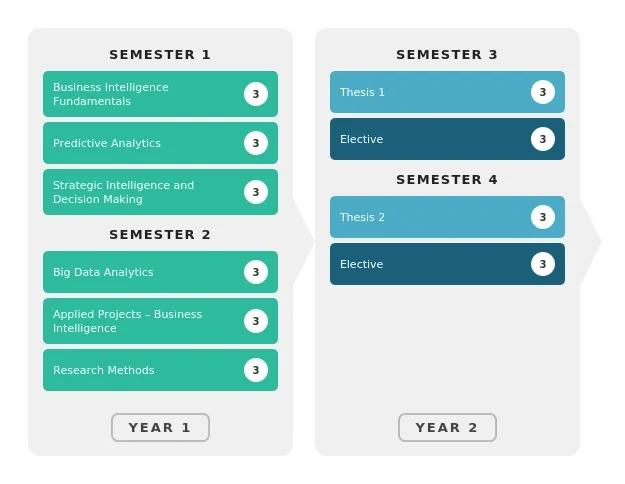
For graduate degree completion, graduate students must satisfy the following requirements:
1.) Earn a minimum CGPA of 2.00 on a scale of 4.00.
2.) Successfully complete all courses as described in the study plan.
3.) The Degree Completion requirements must be met within the timeframe of the program.
4.) Successfully complete the "Thesis" course.
Please Click Here to know more


