


Graphic Design, being one of the foremost means of communication today, allows students to develop personal visual responses that will stand out from the crowd. Students will have the opportunity to create ground breaking designs to meet a variety of graphic needs, including advertising, packaging, print media, branding and web production. Many companies rely on graphic arts professionals to create brand communications concerning their business objectives. A degree in the Graphic Design program from AUE can help you to take your creative talents into the fast-paced business world.
Large design studios, state-of-the-art electronic media, printing facilities and an extensive library are all on hand for students to use in an open and engaging learning environment.
Good design is good business! Graphic Design at AUE offers students the chance to study a diverse range of disciplines including packaging, branding, advertising and publishing in order to ensure the most up-to-date training in professional design.
At AUE, we encourage learners to develop technical, creative and critical thinking skills that are essential to succeed in today’s demanding design industry. Students will be encouraged to develop ideas through experimentation and investigation, with the aim of challenging them to explore the broadest possibilities when responding to design briefs. Our inspirational lectures, workshops, presentations and tutorial support are designed to give students the best possible introduction to a career in design across a wide range of media.

| Course Category | Total Number of Courses | Total Number of Credit Hours |
|---|---|---|
| General Education Courses | 10 | 30 |
| Core Courses | 11 | 33 |
| Specialization Courses | 16 | 48 |
| Free Electives | 5 | 15 |
| Total | 43 Courses | 126 Credit Hours |
| Course Name | Course Code | Credit Hours | Course Description |
|---|---|---|---|
| Academic Writing | ENG 101 | 3 | This course provides students with advanced writing skills in English so that they can successfully pursue their studies in various academic specializations. It helps students to develop, improve, and upgrade their writing and structure skills, and it also acquaints students with technical writing, research papers, and essays since brief research methods are applied in student projects and assignments. |
| Arabic Composition | ARLAA 105 | 3 | This course is designed to enable students to analyze multiple texts in various fields of knowledge. In order to be able to distinguish between texts despite their difference of contents, it also enables student to simulate those texts in a correct way, and to transform the information into skill and behavior. And since writing is an integrated building process, and that the building is affected by its parts, therefore student needs models, linguistic laws, planning, cohesion and goals including: news and inquiries, demand and influence of the recipient. |
| Arabic for Non Arab Speakers | ARLNA 100 | 3 | This course is based on the principle that "Education" is an accumulative task especially when it comes to language learning. This process undergoes specific stages to assist the non-Arabic speakers to reach the ultimate goal which is to acquire the required skills (listening, speaking, reading, writing) easily and accurately. To achieve this aim, text-based dialogues are provided as head start for the non-Arabic speakers to continue to the higher levels. The course also provides basic elements for reading, writing, dialogues, and listening to assist the learners to confidently interact with the Arab community |
| Communication Skills in Arabic | ARLAA 100 | 3 | This course is designed to enable the Arabic-speaking student with the necessary language skills, especially focusing on the steps of writing reports, official letters and systematic research. To achieve this, and to develop the student's abilities to understand correctly what he reads and listens, and to gain the ability to write articles, reports, meeting minutes and recommendations of conferences and seminars in a sound manner, the course was concerned with training the student in basic writing skills; such as multiple spelling rules, punctuation marks, paragraph system, and essay writing progressively. |
| Contemporary Arab Art | DES 104 | 3 | This course explores Arab art and aesthetics from the beginning of the twentieth century till date. The students will learn about the contemporary art and design movement in Arab countries, the expression of cultural identity, as well as the factors involved and changes in aesthetics from Islamic to Arabic art. They will also study and analyze the role of pioneer artists from various generations with emphasis on their influence on contemporary Arab art. |
| Emirati Studies (formerly UAE and GCC Society) | ASC 208 | 3 | The course is designed to introduce the UAE and GCC society with its historical background and uniqueness. It is aimed at enabling students to understand the specific features of the society along with its customs, traditions and lifestyle. The course will introduce the processes and the challenges of development as well as the future aspirations of the UAE and GCC Society. |
| English Literature | ENG 200 | 3 | This course will provide the students with a comprehensive overview of English literature in the United States. It will familiarize the students primarily with early Anglo-American writers and the different literary movements that took place in the United States. Today American literature includes many minority literary works, but the historical matrix remains Anglo-Saxon if we are to consider the dominant culture as the starting historical point. |
| Environmental Science | ASC 211 | 3 | The ‘Principles of Environmental Science’ course is designed to introduce the fundamental concepts of Environmental Science to undergraduate students. It includes topics from different areas of study such as ecology, biology, soil science and atmospheric science. The course aims at raising environmental awareness among students and providing them with the scientific knowledge and skills to identify, prevent and solve environmental problems. Additionally, it deals with ecological concepts, organism interactions, communities and ecosystems. The course focuses on key areas of population dynamics, biodiversity, human activities and the environment managed ecosystems, air quality, water and solid waste management. |
| General Mathematics | MAT 100 | 3 | This course is designed to develop a good understanding of the fundamental concepts of mathematics. It also stresses on crucial cognitive transferable skills such as the ability to think logically and concisely. Mastering this course will give students the confidence to go on and do further courses in mathematics and statistics. |
| General Psychology | ASC 200 | 3 | An introduction to the science of psychology, its theories and foundations. The course is focused on principles and research methodologies, including the following topics: history of psychology, the biology of mind, memory, learning, child and personality development, psychological disorders and therapy. The aim of the course is to introduce the basis of psychology, provide the foundational knowledge to pursue the subject in more depth in the future, and build an ongoing interest in the application of psychology in everyday life. |
| History of Islamic Art | DES 105 | 3 | This course aims to focus on the evolution of Islamic Art through a chronological overview of various ?trends and approaches throughout history. Students will explore and analyze the rise and influence of ?Islam leading to the formation of a new artistic culture the world over.? |
| Innovation and Entrepreneurship | MGT 604 | 3 | This course marks students’ introduction to the theory and practice of innovation and entrepreneurship. Whether they are creating an opportunity or seizing an existing one students explore the core concepts and tools for creating new products or services, new businesses, or new markets from a multilayered perspective. The course examines the fundamentals of innovation in a multitude of settings, operationalizing the entrepreneurial spirit via a comprehensive business plan, and making decisions in the areas of strategic planning, financing, marketing, process improvement, and management with an awareness of the opportunities and challenges of working in an increasingly complex environment regionally and internationally. |
| Introduction to Anthropology | ASC 102 | 3 | This course provides an understanding of anthropology, the study of human beings throughout time and space. Anthropology is a broad discipline that studies human from a holistic perspective looking at both biological and cultural aspects. Anthropologists use different methods in order to understand and study humans. During this course, students will experience ethnographic fieldwork. |
| Introduction to Geography | ASC 206 | 3 | This course will provide the students with a comprehensive overview of geography. Emphasis is on concepts that are necessary to understand global, regional and local issues. This course also includes topics on both human and physical geography. |
| Introduction to Philosophy | ASC 201 | 3 | This course will introduce the students to the key concepts of philosophy and its principle tools. The course will discuss the schools of philosophical thought, and will apply philosophical analysis to the topics of knowledge, religion, mind, freedom, responsibility, and ethics. |
| Introduction to Political Science | ASC 202 | 3 | This course will introduce the students to the key concepts of Political Science and its principal tools. The course will discuss the role of main political actors in the field of politics and their function. |
| Introduction to Research | ASC 207 | 3 | The intent of this course is two-fold. First, it introduces students with the basic research terminologies. Second, it familiarizes them with the process of research from choosing a topic to writing the proposal. Students will be immersed in hands on experience where they will be introduced to research concepts that will help them understand, interpret, and review a journal article. Contents to be covered include the language of research, types of research, elements of scientific research proposal, writing an academic research proposal using APA style, research ethics, identifying data collection instruments, and interpreting data. |
| Introduction to Social Sciences | ASC 110 | 3 | This course serves as an introduction into the interdisciplinary and multifaceted social sciences. The content on the course covers the range of different disciplines that social sciences consists of, namely: anthropology, sociology, psychology, political science, economics and to a lesser extent also history and geography. The secondary aim of the course is moreover for students to develop their critical thinking skills by engaging actively with material about social issues, social change and social institutions. |
| Introduction to Sociology | ASC 104 | 3 | This course introduces the science of Sociology. Students will examine Society, Institutions and the relationships that make up a social context. The scientific methodology used to study social interactions, stratification and other elements of sociological enquiry will be discussed to emphasize the core concept of sociology as a systematic study of societies and social structures. |
| Islamic Civilization | ASC 106 | 3 | The course is designed to give an in-depth understanding of the Islamic civilization. It deals with the universal principles that went into the making of the Islamic civilization. It examines the basic ideas of Islamic civilization besides exploring their contemporary relevance and challenges. The course seeks to effectively address the notion of the ‘clash of civilizations. |
| Islamic Culture | ASC 105 | 3 | This course will expand students’ knowledge to enable them to understand the Islamic culture and its characteristics. It analyzes the sources of legislation in Islam. It offers a review of the history of Islam and how it is currently the fastest growing religion in the world. |
| Middle East History | ASC 204 | 3 | This course provides an overview of Middle-Eastern History, including the sources of Middle Eastern History. The course will conclude with discussions about perspectives on Middle-Eastern History. |
| Natural Science | ASC 210 | 3 | The natural science course incorporates a wide range of subjects of sciences such as astronomy, geology, biology, chemistry, and environmental science. The course will present the scientific facts of astronomy, the Earth and its weather, water, and environment, biology, and nutrition with the chemicals of life. The course emphasizes understanding the core principles of different branches of science and their effects on our lives. Moreover, the course explores the scope of natural phenomena, changing environment conditions, general health rules of nutrition, and the variety of living organisms. The course helps the students to acquire skills in observation, critical thinking, analyzing, interpreting, understanding and discussing scientific terminology and facts. |
| Sustainable Energy | ASC 212 | 3 | This course gives a thorough introduction to sustainable energy, conservation, and energy efficiency within the UAE and the world. It will explore the relationship between energy, environment, economy and ecological well-being. It will discuss energy production from the biology, natural science, environmental science and social sciences perspectives. A variety of topics will be introduced including global warming, climate change, sustainable food production, solid waste management, environmental and natural resources laws. The course includes the growing challenges of climate change and energy crisis and proposes solutions to overcome them. |
| University Life | ASC 101 | 3 | The purpose of this course is to facilitate the process of transition into a new academic and cultural environment for the new students enrolled in the AUE. Furthermore, it aims to promote their confidence so that they can succeed and meet the academic requirements. The course assimilates academic content with interactive in class activities to ensure an understanding of curricular options and begin to develop a future career plan through self-reflection. |
| World History | ASC 203 | 3 | This course provides an overview of World / General History. The course will conclude with discussions about perspectives on World History. It surveys the history of humankind since 250CE till 1990 CE. In addition, interregional, comparative, cross-cultural, transnational, and historiographical topics will be considered. The objective of the course is to explore the roots of contemporary globalization and to develop historical thinking and writing. |
| Course Name | Course Code | Credit Hours | Course Description |
|---|---|---|---|
| 3D Design | DES 212 | 3 | In this course, students will learn various techniques to construct objects in digital 3D space, as well as physical 3D solutions. Students will follow a concept development process of research and sketching, to generate designs for 3D production. A final original design, related to each student’s major, will be constructed using industry-standard 3D software. |
| Art History I | DES 122 | 3 | This course is a chronological survey of art and design offering students an in-depth understanding of the role of art throughout history with a strong focus on aesthetic values, socio-cultural influences and technical terminology. Architecture, sculpture, painting, decorative arts, prehistoric art, design of the ancient world, the world beyond Europe, early Christian and Islamic art and the art of the Middle-Ages and Gothic period form the foundation of the course material spanning a period from 40,000 BC to 1300 AD. |
| Art History II | DES 211 | 3 | This course covers the extensive cultural shifts from the early Renaissance through to the 20th century. Students will study painting, sculpture, furniture architecture as individual works in relation to their geographical, social, political, and religious environments. Also, analysis and comparative study of periodic decorative elements, strong designs and architectural features will be conducted. |
| Basic Design | DES 101 | 3 | This course is one of the fundamental courses in which the students will be introduced to the visual elements of design comprising of: point and line; shape and form; surface and texture; color and value; light and shadow; negative and positive space. The students will practice design principles: unity and variety; similarity; emphasis and point of interest; scale; proportion; and balance. This course is designed to give the students a strong understanding of 2D and 3D visual communications. |
| Collaborative Design Studio | DES 414 | 3 | The course is designed to promote interdisciplinary collaboration in design. Graphic, Interior, Fashion Design and Digital Animation are brought together into one studio environment to allow students with different skills and strengths work as a team solving a relatively complex design problem. Students develop a research plan followed by the establishment of intent and context for the topic and identification of stakeholders, leading to concept exploration and creation of a holistic design solution in cooperation with other specializations, institutes or with professionals from the industry. |
| Color Theory and Practice | DES 100 | 3 | This course examines color theory as an aid to communication, control and expression in traditional and contemporary design. The fundamental course allows students to explore color topics including color theory, color interaction, and color psychology. Students will study a wide range of creative and technical aspects of color and its use in design, experimenting with traditional mediums and digital applications. |
| Design Thinking | DES 210 | 3 | This course introduces students to human centered design thinking methods and practices through a variety of hands-on activities. DT is a methodology used by designers for the identification of problems and the definition of innovative solutions. Students will engage in processes for idea generation including sketching and diagramming, concept mapping and low-fidelity prototyping infusing visualization techniques and empathic tools into their design process. |
| Drawing I | DES 121 | 3 | This course provides a core introduction to drawing, covering a wide range of basic and intermediate practical and technical skills. Students will explore approaches and concepts to the subject through manual practice using a comprehensive range of media and with reference to great masters in the field. Traditional and objective drawing skills in the use of line, tone, form and perspective provide the foundation for learning in this course. Students are required to develop their ability to observe, perceive and interpret through drawing the world around them, reflecting their understanding of 2D and 3D space. |
| Drawing II | DES 123 | 3 | This course introduces students to different drawing concepts and skills through observation and exploration of several drawing techniques. In this course, students will develop the ability to express themselves, learn problem solving, and exploring portraiture, figure drawing, landscape drawing, and advanced compositions. Critical thinking skills, problem-solving, and a self-directed improvement capability are essentially required for this course. |
| Fundamentals of Graphic Illustration and Digital Imaging | DES 102 | 3 | Fundamentals of Graphic Illustration and Digital Imaging introduces students to the use of a computer as a powerful digital drawing and imaging tool. The focus of the course is on basic computer skills and use, mastering fundamental digital illustration and imaging skills, and developing efficient working styles. The course learning experience incorporates a variety of visual artwork strategies including but not limited to, color/ texture enhancements, typography, pen/ brush tools, , perspective tool, using different color schemes. This course involves considerable hands-on instruction and multiple projects using Adobe Photoshop/ Illustrator. |
| Internship | DES 301 / FAD 300 / FAD 305 | 3 | The college considers students’ internship as an essential channel that brings together the college, the students, and the job marketplace. Furthermore, internship is a method that integrates the instructional theoretical backgrounds to real existing practice. The training allows them to work under the observation and guidance of the field supervisor without replacing any regular employee. The internship is closely monitored by a college faculty member as an academic supervisor. |
| Course Name | Course Code | Credit Hours | Course Description |
|---|---|---|---|
| Arabic Typography | GRD 313 | 3 | This course offers an in-depth examination of Arabic Typography, encompassing its historical development, contemporary applications, and associated challenges. The emphasis is on employing Arabic Typography within design contexts and comprehending the essentials of Arabic typography design, striving to achieve equilibrium between functionality, legibility, and aesthetic allure. Through practical sessions, discussion, and exploration of relevant software, students will delve into the bedrock of Arabic type design. This entails drawing inspiration from historical practices while simultaneously addressing current design challenges and applications. The course is designed to equip students with the skills needed for nuanced and effective use of Arabic typography in their future careers. |
| Capstone Graduation Preparation | 5 | This course is designed to equip students with the necessary knowledge and skills to effectively prepare for their capstone graduation project. Through a series of inclass and out-class activities, students will gain an understanding of the project requirements, learn how to select a suitable topic, conduct research and visual analysis, develop design concepts, and case study discussion. This course will provide students with the foundational tools and guidance they need to successfully undertake their capstone graduation project. |
|
| Capstone Graduation Project | GRD 423 | 3 | The capstone graduation project is the representation of the students’ in-depth learning and understanding of their field of specialization through a long-term project accomplished in a professional manner. They are evaluated on their ability to complete this project with originality and quality, applying the skills, techniques, and methodologies they have learnt during their course of study. |
| Figure Drawing (Life Drawing) | GRD 221 | 3 | Students will develop an in-depth knowledge of human anatomy and figure construction through exploration of the skeletal, muscular and surface systems of the human body. Portraiture and facial expression also form part of the course. Classic technique and personal interpretation will be explored through intensive studio practice based on direct observation of the model examining shape, form, line, tone, value, texture, weight, balance, stress and movement. Advanced composition, sophisticated mark-making and the development of personal expression, interpretation and visual fluency are key in this course as well as thoughtful and constructive participation in group critiques using appropriate terminology. |
| Graphic Design I | GRD 225 | 3 | This course is an introductory exploration into the dynamic realm of graphic design and visual communication design systems. Building upon existing knowledge, students will delve into the fundamental elements of design, including spatial relationships, typography, hierarchy, color management, and imagery. The course is structured to empower students with the skills to conceptualize and execute practical visual solutions. Through a series of engaging projects, students will tackle basic design problems, employing a thoughtful investigation of design elements and principles. |
| Graphic Design II | GRD 312 | 6 | This course focuses on brand design and identity through a series of exercises and projects. Students will utilize a range of acquired art and design skills to investigate existing design work, and generate original visual communication solutions and demonstrate effective design thinking. They are exposed to industry standards and international practices, and will learn to interpret design briefs, responding to the needs and specifications of the client. |
| History of Graphic Design | GRD 222 | 3 | This course explores the evolution of graphic communication from prehistory through postmodern design and the digital revolution. Building on the learning experiences of Art History I and II, as well as historical information gleaned from other courses, students will develop a clear and chronological grasp of the evolution of Graphic Design principles and practices throughout history, with particular focus on the role of mass production, printing, mass media and digital developments. Students will consider the impact of technological advances and enhancements as well as reflect on the comparisons and contrasts that can be found across all areas of visual communication throughout time. This will be communicated through a series of quizzes, exams, written essays and papers in which students are required to make cogent and well-informed observations on the evolution of this field. |
| Information Design | GRD 321 | 3 | This course explores the theory and practice of information design and presentation. It introduces students to the design, presentation, and communication of information in a range of media. The emphases on information types, methods and modes of presentation, and document design and layout. The main objective is to develop understanding of design principles and increase critical awareness of information presentation techniques. Topics include the study of sign systems, way-finding methods, ideographs and symbol-based communication, charts, graphs and public information. Topics include: corporate communication systems, publication, way-finding, interaction design, etc. |
| Interactive Communication Design (formerly Communication Design) | GRD 311 | 3 | This course explores communication design theories, methods, and practices with a specific focus on designing interactive digital experiences for various digital platforms. Students will also utilize industry-standard tools and software to create high-fidelity design prototypes and interactive digital experiences by providing an appropriate design solution. |
| Introduction to Digital Video Production | GRD 314 | 3 | This course covers the theory of digital production, compositing and working in digital formats. Students will follow the production pipeline to learn story development through scripting, storyboarding, video recording and editing, lighting techniques, audio production and to author original content. Students will work with different narrative structures to tell a compelling story. |
| Layout and Editorial Design | GRD 412 | 3 | This course explores advanced techniques in layout and editorial design for both digital and print publications. Through the integration of technology and creative concepts, students will explore cutting-edge innovations in graphic design. Students are expected to create visually appealing and dynamic layouts for a variety of media to meet industry standards. |
| Motion Graphics | GRD 323 | 3 | This course introduces the theory and production of motion graphics utilizing industry-standard software and current broadcast techniques with emphasis on classic animation principles and workflow. The focus is on animating with typography, graphic symbols, shapes and color, to design and produce highly compelling time-based motion graphics and typography for broadcast, web, and mobile platforms. |
| Special Topics in Design | FSD 422 | 3 | This course provides an opportunity for students to focus on various issues in fashion design and to study advanced techniques and processes. Course content vary each time the course is offered. The course emphasizes research analysis and the creative process that leads to innovative solutions and allows students to pursue individual projects related to the subject of the course. The course may include lectures, discussions, individual projects and critique, depending on the nature of the topic. |
| Sustainable Packaging Design | GRD 316 | 3 | This course familiarizes students with sustainable packaging design, emphasizing eco-friendly approaches, structural innovation, and visually compelling solutions throughout the entire packaging design process. It explores three-dimensional packaging structures for a diverse range of products, prioritizing environmental sustainability and user experience. From initial sketches to final presentations, students will sharpen their skills in conceptual development, prototyping, typography, structural and visual design, and material considerations, with assignments spanning across various product categories. |
| Typography I | GRD 214 | 3 | Typography-I is the study of letterforms including their purpose as communication tools, type anatomy, syntax, and their evolution with technologies in printing and new media. This course will provide the student with a foundation to understand the evolution of typography from both historical and conceptual perspective. Students will be exposed to a vocabulary of professional terms to articulately communicate their ideas with their peers, and their future associates and clients. In addition, students will learn to incorporate the basic principles of typography with the essential technical skills necessary to achieve success in graphic design and advertising. |
| Typography II | GRD 224 | 3 | This course is an in-depth examination of the function of typography as a visual element within the larger context of graphic communication. Students will explore the role that typography plays in shaping the form and content of visual communication. It expands their thinking and practice related to diverse forms of visual expression and enhance their abilities to visualize and communicate complex information that is mainly typographic. Through reading, research, critique, studio practice and design production students will explore a variety of advanced design problems and build skills in communicating visual meaning. |
| Course Name | Course Code | Credit Hours | Course Description |
|---|---|---|---|
| Free Elective | 15 | 15 Credit Hours must be chosen from any other college/specialization in condition the prerequisites of the chosen courses are met. |
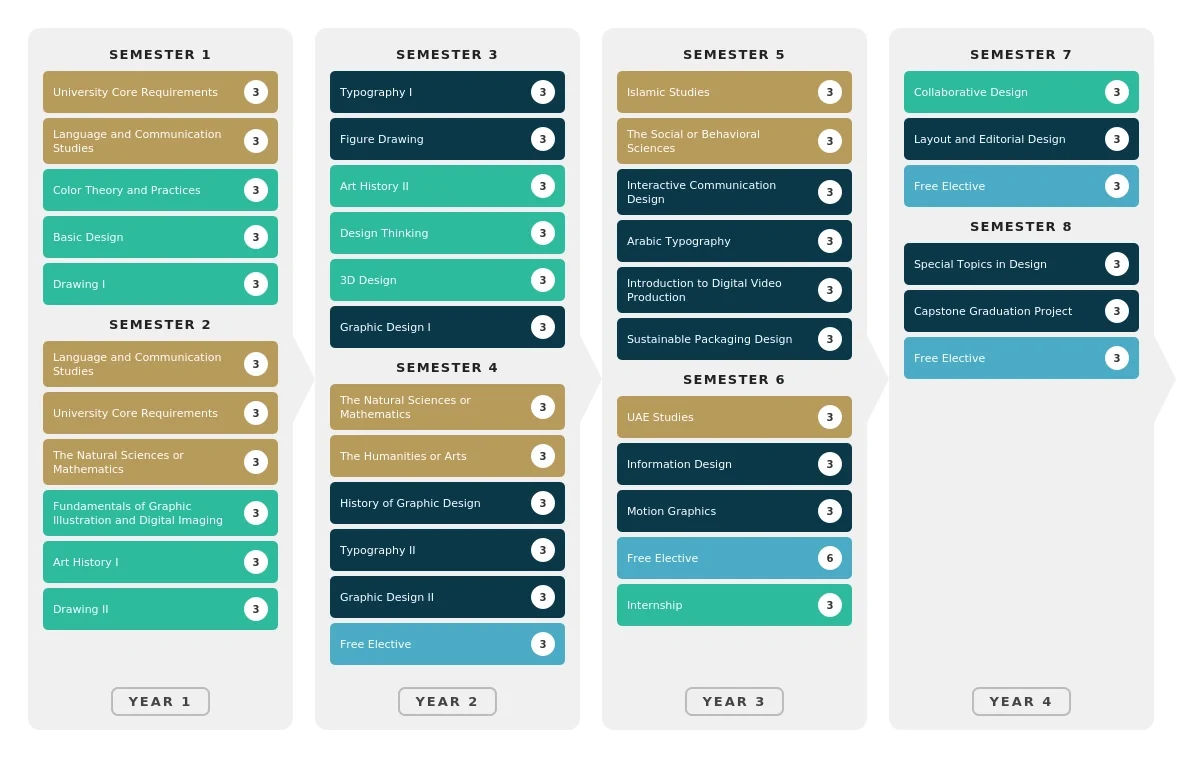
For undergraduate degree completion, undergraduate students must satisfy the following requirements:


