Admission

Start your journey

Fall, Spring and Summer intakes, with an admissions team to guide you every step.

Admission overview →

Research

Driving future discoveries

Research centers, conferences and partnerships with global institutions.

About research →

Alumni

Once AUE, always AUE

Stay connected with 5,611+ graduates around the world.

Alumni home →

News & Media

What's happening at AUE

News, events and publications from across our campus community.

All news →

Bachelor of Science in Network Security

Introduction

About the Program

Securing Technological Platforms

The College of Engineering and Technology’s innovative Network Security specialization program is offered to meet critical business environment needs, guided by industry trends, driven by technology, and constantly evolving. The demand for security specialists in the region is constantly growing.

The program focuses on the practical and theoretical dimensions of cyber security across a range of fundamental areas, such as network security, vulnerability assessment, information security, wireless devices security, business continuity, cloud security, and database security.

The emphasis of the program is to prepare students with the knowledge and skills necessary to secure LAN/WAN, computers, detect and analyze attacks and threats, respond to attacks, develop security policies, procedures, and standards.

Mission

The mission of the computer science program is to equip students with a robust foundation in computer science and information technology, preparing them for competitive careers and industry challenges. We aim to foster teamwork, ensuring our graduates can contribute significantly to organizational goals and demonstrate effective communication skills.

Our program emphasizes adherence to ethical and legal standards, encouraging responsible professional conduct. We are committed to promoting lifelong learning, enabling graduates to acquire advanced knowledge and skills, adapt to technological advancements, and address societal needs.

Program Educational Objectives

1
Secure a competitive career in the field of computer science or related disciplines, demonstrating a strong foundation and readiness for industry challenges.
2
Contribute significantly as a team member in achieving the organization’s mission, displaying teamwork skills and a commitment to organizational objectives.
3
Communicate effectively through various methods.
4
Adhere to ethical and legal standards and policies and assess the implications of professional activities responsibly.
5
Engage in lifelong learning to acquire advanced professional knowledge and skills, facilitating career advancement and responsiveness to the evolving landscape of technology and societal needs.

Program Learning Outcomes (Student Outcomes)

1
Analyze a complex computing problem and apply principles of computing and other relevant disciplines to identify solutions.
2
Design, implement, and evaluate a computing-based solution to meet a given set of computing requirements in the context of the program’s discipline.
3
Communicate effectively in a variety of professional contexts.
4
Recognize professional responsibilities and make informed judgments in computing practice based on legal and ethical principles.
5
Function effectively as a member or leader of a team engaged in activities appropriate to the program’s discipline.
6
Apply computer science theory and software development fundamentals to produce computing-based solutions.

Program at a glance


Total Credit Hours

126 Credit Hours

Duration

4 Years

Instruction Language

English

Quality assured

Accreditations

Accredited by ABET
Accredited by CAA

Program Director

Dr. Alyaa Amer

Assistant Professor

Credit breakdown

Program Structure

Course CategoryTotal Number of CoursesTotal Number of Credit Hours
General Education Courses1030
Core Courses2681
Specialization Courses515
Total41 Courses126 Credit Hours

Curriculum

Courses & Descriptions

ENG 101 Academic Writing 3 CH
ARLAA 105 Arabic Composition 3 CH
ARLNA 100 Arabic for Non Arab Speakers 3 CH
ARLAA 100 Communication Skills in Arabic 3 CH
DES 104 Contemporary Arab Art 3 CH
ASC 208 Emirati Studies (formerly UAE and GCC Society) 3 CH
ENG 200 English Literature 3 CH
ASC 211 Environmental Science 3 CH
MAT 100 General Mathematics 3 CH
DES 105 History of Islamic Art 3 CH
MGT 604 Innovation and Entrepreneurship 3 CH
ASC 219 Introduction to AI 3 CH
ASC 201 Introduction to Philosophy 3 CH
ASC 207 Introduction to Research 3 CH
ASC 106 Islamic Civilization 3 CH
ASC 105 Islamic Culture 3 CH
ASC 204 Middle East History 3 CH
ASC 210 Natural Science 3 CH
ASC 212 Sustainable Energy 3 CH
ASC 101 University Life 3 CH
ASC 203 World History 3 CH
CSC 412 Advanced Topics in Computer Science 3 CH
CET 470 Artificial Intelligence 3 CH
MAT 110 Calculus 1 3 CH
MTH 102 Calculus II 3 CH
CIT 416 Capstone Graduation Project 3 CH
CET 444 Computer Architecture and Organization 3 CH
CIT 307 Computer Ethics 3 CH
CIT 311 Data Analytics 3 CH
BCE 212 Data Structures and Algorithms 3 CH
CIT 212 Database Systems 3 CH
CET 240 / CSC 201 Digital Logic and Design 3 CH
MTH 200 Discrete Mathematics 3 CH
CIT 305 Internship 2 CH
CSC 110 Introduction to Computer System 3 CH
CET 346 Introduction to Operating Systems 3 CH
CIT 201 Introduction to Programming 3 CH
MGT 105 Introduction to Statistics (formerly General Statistics) 3 CH
MTH 210 Linear Algebra 3 CH
CSC 315 Modern Programming Languages 3 CH
BCE 200 / CSC 302 Network Essentials 3 CH
CET 210 Object Oriented Programming 3 CH
PHY 100 Physics 1 3 CH
PHY 200 Physics 2 3 CH
CSC 401 Software Engineering 3 CH
CSC 304 Theory of Computation 3 CH
CIT 205 Website Design 3 CH
CSCS 305 Computer Security 3 CH
CSCS 421 Ethical Hacking and Penetration Testing 3 CH
CSCS 303 Information Security 3 CH
CSCS 401 Mobile and Wireless Security (formerly Mobile Technology) 3 CH
CSC-S 310 Network Security 3 CH
ITM 306 Server Operating System and Network Management 3 CH

Semester by semester

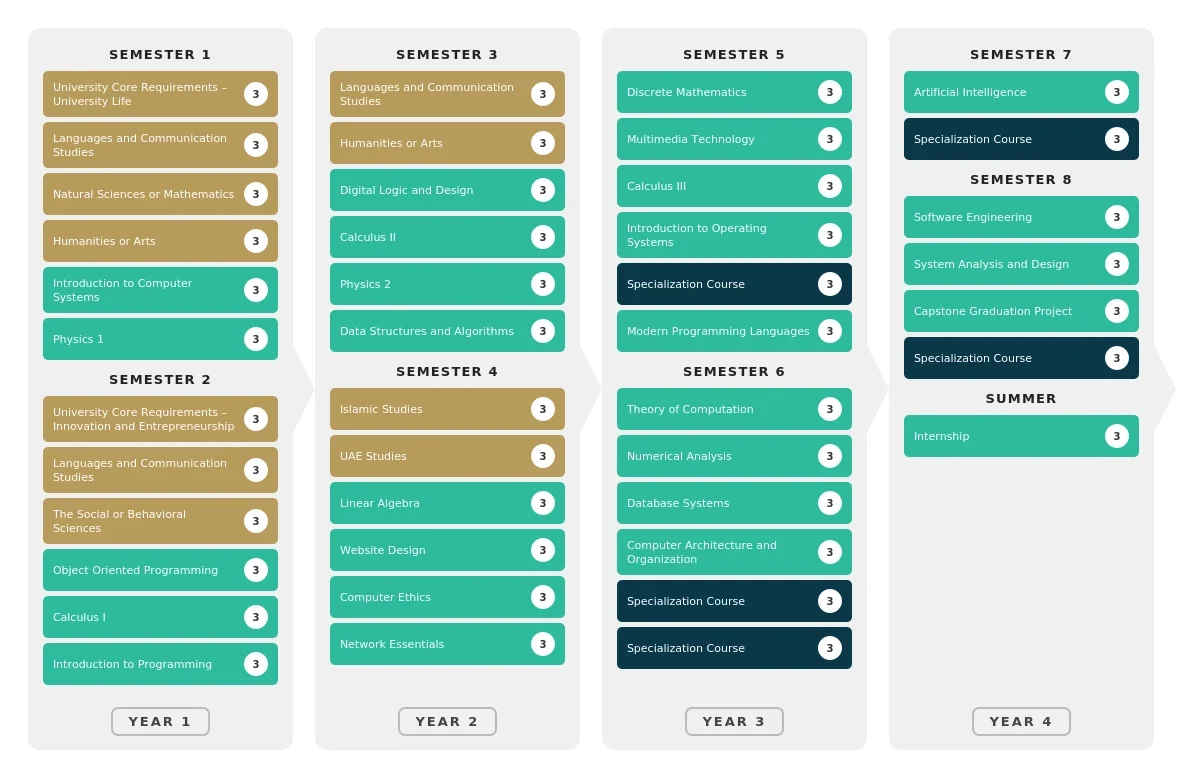
Study Plan

4
Credit hours
126
Duration
4 years
Terms
9

Swipe to see each year →

  1. Year 1

    Semester 1

    • — 3 CH General Education University Core Requirements – University Life
    • — 3 CH General Education Languages and Communication Studies
    • — 3 CH General Education Natural Sciences or Mathematics
    • — 3 CH General Education Humanities or Arts
    • CSC 110 3 CH Introduction to Computer Systems Core Courses
    • PHY 100 3 CH Physics 1 Core Courses

    Semester 2

    • — 3 CH General Education University Core Requirements – Innovation and Entrepreneurship
    • — 3 CH General Education Languages and Communication Studies
    • — 3 CH General Education The Social or Behavioral Sciences
    • PHY 200 3 CH Physics 2 Core Courses
    • — 3 CH Calculus I Core Courses
    • — 3 CH General Statistics Core Courses
  2. Year 2

    Semester 3

    • — 3 CH General Education Languages and Communication Studies
    • — 3 CH General Education Humanities or Arts
    • CIT 201 3 CH Introduction to Programming Core Courses
    • CET 210 3 CH Object Oriented Programming Core Courses
    • CET 240 / CSC 201 3 CH Digital Logic and Design Core Courses
    • MTH 102 3 CH Calculus II Core Courses

    Semester 4

    • — 3 CH General Education Islamic Studies
    • — 3 CH General Education UAE Studies
    • BCE 212 3 CH Data Structures and Algorithms Core Courses
    • MTH 210 3 CH Linear Algebra Core Courses
    • CIT 205 3 CH Website Design Core Courses
    • MTH 200 3 CH Discrete Mathematics Core Courses
  3. Year 3

    Semester 5

    • CET 346 3 CH Introduction to Operating Systems Core Courses
    • BCE 200 / CSC 302 3 CH Network Essentials Core Courses
    • CIT 311 3 CH Data Analytics Core Courses
    • CIT 212 3 CH Database Systems Core Courses
    • — 3 CH Specialization Course
    • CSC 315 3 CH Modern Programming Languages Core Courses

    Semester 6

    • CET 444 3 CH Computer Architecture and Organization Core Courses
    • CIT 307 3 CH Computer Ethics Core Courses
    • — 3 CH Specialization Course
    • — 3 CH Specialization Course
  4. Year 4

    Semester 7

    • CET 470 3 CH Artificial Intelligence Core Courses
    • CSC 401 3 CH Software Engineering Core Courses
    • — 3 CH Specialization Course

    Semester 8

    • CSC 304 3 CH Theory of Computation Core Courses
    • — 3 CH Advanced Topics in CS Core Courses
    • CIT 416 3 CH Capstone Graduation Project Core Courses
    • — 3 CH Specialization Course

    Summer

    • CIT 305 6 CH Internship Core Courses
Study Plan - Bachelor of Science in Network Security

What we aim for

Program Goals

Program Goals
  1. Have a graduate degree or professional career in computer science or related disciplines.
  2. Become successful researchers, team members or leaders.
  3. Maintain high standards of work ethics, social responsibilities and professionalism.
  4. Specialize in solving technical problems using computing knowledge, skills and competence.
  5. Be creative, effective, and productive members of the local, regional and international communities.

What you will learn

Program Learning Outcomes

Program Learning Outcomes
  1. Analyze a complex computing problem and to apply principles of computing and other relevant disciplines to identify solutions.
  2. Design, implement, and evaluate a computing-based solution to meet a given set of computing requirements in the context of the program’s discipline.
  3. Communicate effectively in a variety of professional contexts.
  4. Recognize professional responsibilities and make informed judgments in computing practice based on legal and ethical principles.
  5. Function effectively as a member or leader of a team engaged in activities appropriate to the program’s discipline.
  6. Apply computer science theory and software development fundamentals to produce computing-based solutions.

Requirements

Program Requirements

Graduation Requirements

For undergraduate degree completion, undergraduate students must satisfy the following requirements:
1. Earn a minimum CGPA of 2.00 on a scale of 4.00.
2. Successfully complete all courses as described in the study plan.
3. The Degree Completion requirements must be met within the timeframe of the program.
4. Transfer students must successfully earn a minimum of 50% of the course credits for the program at AUE.

Admission Requirements

When can I join?

Three intakes every year

Students can join at the beginning of any semester.

Intake 01

September

Fall Semester


Intake 02

January

Spring Semester


Intake 03

May

Summer Semester


Ready to plan your path?
Submit Your Application and Join AUE Today

About AUE

Academics

Admission

Research

Students

Alumni

News & Media

Login

Apply Now