


The College of Engineering and Technology (CET) offers a specialized program in the field of Information Technology Management. The program has been designed by information technology professionals to assist students in building their career in the IT industry.
The curriculum focuses on problem-solving skills and techniques required to deliver computer-based solutions to real-world scenarios. Students develop and communicate technological solutions to different industrial issues, manage systems operations, improve, and simplify the technology transfer into industries and governments. Students learn to implement ethical judgments and critical thinking to measure, and evaluate the impact of information technology on modern social, political, and economic issues.

| Course Category | Total Number of Courses | Total Number of Credit Hours |
|---|---|---|
| General Education Courses | 11 | 33 |
| Core Courses – Business | 8 | 24 |
| Core Courses – IT | 19 | 60 |
| Free Elective | 3 | 9 |
| Total | 41 Courses | 126 Credit Hours |
| Course Name | Course Code | Credit Hours | Course Description |
|---|---|---|---|
| Academic Writing | ENG 101 | 3 | This course provides students with advanced writing skills in English so that they can successfully pursue their studies in various academic specializations. It helps students to develop, improve, and upgrade their writing and structure skills, and it also acquaints students with technical writing, research papers, and essays since brief research methods are applied in student projects and assignments. |
| Arabic Composition | ARLAA 105 | 3 | This course is designed to enable students to analyze multiple texts in various fields of knowledge. In order to be able to distinguish between texts despite their difference of contents, it also enables student to simulate those texts in a correct way, and to transform the information into skill and behavior. And since writing is an integrated building process, and that the building is affected by its parts, therefore student needs models, linguistic laws, planning, cohesion and goals including: news and inquiries, demand and influence of the recipient. |
| Arabic for Non Arab Speakers | ARLNA 100 | 3 | This course is based on the principle that "Education" is an accumulative task especially when it comes to language learning. This process undergoes specific stages to assist the non-Arabic speakers to reach the ultimate goal which is to acquire the required skills (listening, speaking, reading, writing) easily and accurately. To achieve this aim, text-based dialogues are provided as head start for the non-Arabic speakers to continue to the higher levels. The course also provides basic elements for reading, writing, dialogues, and listening to assist the learners to confidently interact with the Arab community |
| Communication Skills in Arabic | ARLAA 100 | 3 | This course is designed to enable the Arabic-speaking student with the necessary language skills, especially focusing on the steps of writing reports, official letters and systematic research. To achieve this, and to develop the student's abilities to understand correctly what he reads and listens, and to gain the ability to write articles, reports, meeting minutes and recommendations of conferences and seminars in a sound manner, the course was concerned with training the student in basic writing skills; such as multiple spelling rules, punctuation marks, paragraph system, and essay writing progressively. |
| Contemporary Arab Art | DES 104 | 3 | This course explores Arab art and aesthetics from the beginning of the twentieth century till date. The students will learn about the contemporary art and design movement in Arab countries, the expression of cultural identity, as well as the factors involved and changes in aesthetics from Islamic to Arabic art. They will also study and analyze the role of pioneer artists from various generations with emphasis on their influence on contemporary Arab art. |
| Emirati Studies (formerly UAE and GCC Society) | ASC 208 | 3 | The course is designed to introduce the UAE and GCC society with its historical background and uniqueness. It is aimed at enabling students to understand the specific features of the society along with its customs, traditions and lifestyle. The course will introduce the processes and the challenges of development as well as the future aspirations of the UAE and GCC Society. |
| English Literature | ENG 200 | 3 | This course will provide the students with a comprehensive overview of English literature in the United States. It will familiarize the students primarily with early Anglo-American writers and the different literary movements that took place in the United States. Today American literature includes many minority literary works, but the historical matrix remains Anglo-Saxon if we are to consider the dominant culture as the starting historical point. |
| Environmental Science | ASC 211 | 3 | The ‘Principles of Environmental Science’ course is designed to introduce the fundamental concepts of Environmental Science to undergraduate students. It includes topics from different areas of study such as ecology, biology, soil science and atmospheric science. The course aims at raising environmental awareness among students and providing them with the scientific knowledge and skills to identify, prevent and solve environmental problems. Additionally, it deals with ecological concepts, organism interactions, communities and ecosystems. The course focuses on key areas of population dynamics, biodiversity, human activities and the environment managed ecosystems, air quality, water and solid waste management. |
| General Mathematics | MAT 100 | 3 | This course is designed to develop a good understanding of the fundamental concepts of mathematics. It also stresses on crucial cognitive transferable skills such as the ability to think logically and concisely. Mastering this course will give students the confidence to go on and do further courses in mathematics and statistics. |
| History of Islamic Art | DES 105 | 3 | This course aims to focus on the evolution of Islamic Art through a chronological overview of various ?trends and approaches throughout history. Students will explore and analyze the rise and influence of ?Islam leading to the formation of a new artistic culture the world over.? |
| Innovation and Entrepreneurship | MGT 604 | 3 | This course marks students’ introduction to the theory and practice of innovation and entrepreneurship. Whether they are creating an opportunity or seizing an existing one students explore the core concepts and tools for creating new products or services, new businesses, or new markets from a multilayered perspective. The course examines the fundamentals of innovation in a multitude of settings, operationalizing the entrepreneurial spirit via a comprehensive business plan, and making decisions in the areas of strategic planning, financing, marketing, process improvement, and management with an awareness of the opportunities and challenges of working in an increasingly complex environment regionally and internationally. |
| Introduction to AI | ASC 219 | 3 | This course offers an introductory exploration of Artificial Intelligence (AI) for students across all disciplines. It focuses on applying AI concepts and tools practically without delving deeply into specialized or theoretical content. Students will learn basic AI concepts through practical exercises, including problem-solving, decision-making, simple machine learning, reinforcement learning, probabilistic learning, and natural language processing. The course will emphasize the impact of AI on society, ethics, and everyday life, preparing students to understand and engage with AI in various contexts. By the end of the course, students will have a comprehensive understanding of artificial intelligence, its branches, and practical applications across real-world domains |
| Introduction to Philosophy | ASC 201 | 3 | This course will introduce the students to the key concepts of philosophy and its principle tools. The course will discuss the schools of philosophical thought, and will apply philosophical analysis to the topics of knowledge, religion, mind, freedom, responsibility, and ethics. |
| Introduction to Research | ASC 207 | 3 | The intent of this course is two-fold. First, it introduces students with the basic research terminologies. Second, it familiarizes them with the process of research from choosing a topic to writing the proposal. Students will be immersed in hands on experience where they will be introduced to research concepts that will help them understand, interpret, and review a journal article. Contents to be covered include the language of research, types of research, elements of scientific research proposal, writing an academic research proposal using APA style, research ethics, identifying data collection instruments, and interpreting data. |
| Islamic Civilization | ASC 106 | 3 | The course is designed to give an in-depth understanding of the Islamic civilization. It deals with the universal principles that went into the making of the Islamic civilization. It examines the basic ideas of Islamic civilization besides exploring their contemporary relevance and challenges. The course seeks to effectively address the notion of the ‘clash of civilizations. |
| Islamic Culture | ASC 105 | 3 | This course will expand students’ knowledge to enable them to understand the Islamic culture and its characteristics. It analyzes the sources of legislation in Islam. It offers a review of the history of Islam and how it is currently the fastest growing religion in the world. |
| Middle East History | ASC 204 | 3 | This course provides an overview of Middle-Eastern History, including the sources of Middle Eastern History. The course will conclude with discussions about perspectives on Middle-Eastern History. |
| Sustainable Energy | ASC 212 | 3 | This course gives a thorough introduction to sustainable energy, conservation, and energy efficiency within the UAE and the world. It will explore the relationship between energy, environment, economy and ecological well-being. It will discuss energy production from the biology, natural science, environmental science and social sciences perspectives. A variety of topics will be introduced including global warming, climate change, sustainable food production, solid waste management, environmental and natural resources laws. The course includes the growing challenges of climate change and energy crisis and proposes solutions to overcome them. |
| University Life | ASC 101 | 3 | The purpose of this course is to facilitate the process of transition into a new academic and cultural environment for the new students enrolled in the AUE. Furthermore, it aims to promote their confidence so that they can succeed and meet the academic requirements. The course assimilates academic content with interactive in class activities to ensure an understanding of curricular options and begin to develop a future career plan through self-reflection. |
| World History | ASC 203 | 3 | This course provides an overview of World / General History. The course will conclude with discussions about perspectives on World History. It surveys the history of humankind since 250CE till 1990 CE. In addition, interregional, comparative, cross-cultural, transnational, and historiographical topics will be considered. The objective of the course is to explore the roots of contemporary globalization and to develop historical thinking and writing. |
| Course Name | Course Code | Credit Hours | Course Description |
|---|---|---|---|
| Business Statistics | MGT 202 | 3 | This course aims to acquire a sound education in those statistical concepts and its applications in the fields of business and economics. This course requires fundamental understanding of basic statistics like frequency distribution, averages, measures of variability, probability, confidence intervals. The course also recommends a prior understanding of software application and MS Excel. Course covers statistical concepts and methods like hypothesis testing, variance Tests, chi-Square analysis and ANOVA with an emphasis on business application |
| Introduction to Statistics (formerly General Statistics) | MGT 105 | 3 | The General Statistics, an introductory course in statistics, discusses the following topics: an introduction to statistical methods; descriptive statistics; the normal distribution, basic techniques of statistical inference; confidence intervals and hypothesis tests for population means and proportions; a comprehensive introduction to probability, probability distributions and sampling. The course uses the software SPSS during laboratory sessions. |
| Management Information System | MGT 200 | 3 | This course is designed to provide students with an in-depth understanding of Management Information Systems (MIS) and their role in business processes, productivity, and competitive advantage. Throughout the course, students will learn the principles, concepts, theories, and processes of MIS, including how they are applied in different industries and business environments. The course will also examine the impact of MIS on organizational decision-making and performance evaluation, as well as how they can be used to solve business problems through teams. The course will cover a variety of topics relevant to information technology, including information systems and their global impact, ethical and social issues in information systems, database and information management, telecommunication and network technology, security, and e-commerce. |
| Microeconomics | ECO 100 | 3 | This course is designed to introduce students to basic microeconomics concepts relating to individual decision-making. The course exposes students to the meaning, nature, and methods of studying Microeconomics. The concepts of supply, demand, and elasticity are used to analyze the behaviors of consumers and firms in different types of markets. The main topics covered include consumer behavior, firm production costs, pure competition, monopolistic competition, monopoly, and oligopoly. |
| Organizational Behavior | MGT 205 | 3 | Organizational behavior studies the influence of individuals, groups, and work culture on behavior within organizations; its chief goal is to improve an organization’s effectiveness. This course introduces students to the core concepts of organizational behavior including attitudes, emotions, and moods; communication; conflict and negotiation; diversity; group behavior and work teams; individual decision making; leadership and power; motivation; organization culture and structure; organizational change; and personality and values. |
| Principles of Accounting | ACC 100 | 3 | This principle-level course introduces students to the fundamentals of accounting terms, rules, concepts, procedures, and systems. Topics covered include the art of recording, classifying, and analyzing the data into useful information for both internal and external users. Students are introduced to the double-entry accounting concepts, general journals, and the accounting cycle. |
| Principles of Management | MGT 100 | 3 | This course marks students’ first journey into the discipline of management. The focus of this course is to expose students to the fundamentals of the four functions of management of planning, organizing, leading and controlling. Within each function students are introduced to a multitude of managerial areas of focus including decision-making, organizational structure, power and politics, leadership, teams, motivation, and communication. |
| Principles of Marketing | MKT 200 | 3 | Principles of Marketing shows students how to create vibrant, interactive communities of consumers who make products and brands an integral part of their daily lives. To help them master this key challenge, this course provides the fundamentals of marketing within an innovative customer-value framework. In this course, students will learn how to create customer value and engagement in order to capture value in return. |
| Course Name | Course Code | Credit Hours | Course Description |
|---|---|---|---|
| Advanced Topics in CIT | CIT 410 | 3 | The course Advanced Topics in CS is designed to provide students with the current and emerging technologies relevant to Computer Science and Information Technology. The course aims at introducing the new advanced concepts, principles, and practices of the modern computing landscape. The course content might vary from one semester to another depending upon the emerging technologies, faculties expertise, and students’ preferences. Advanced Topics in CS course uses a variety of teaching strategies to expose students to real world scenarios, which are current industry challenges. This approach ensures that CS graduates are equipped with the contemporary skill sets required in the ever-changing industry. |
| Business Intelligence and Decision Making | ITM 412 | 3 | This course is designed to provide students with a comprehensive understanding of the concepts, techniques, and tools used in the field of business intelligence. Business intelligence plays a critical role in enabling organizations to make informed decisions, gain valuable insights, and optimize their operations based on data-driven analysis. This course aims to introduce the fundamental principles and practices of Business Intelligence (BI) in modern organizations. The course covers the basic concepts and techniques of BI, including Introduction to Business Intelligence and its Impacts, Business Intelligence Capabilities, Technologies Enabling Business Intelligence, Business Intelligence Tools and Vendors, Development of Business Intelligence, Management of Business Intelligence, and the future of Business Intelligence. |
| Capstone Graduation Project | CIT 416 | 3 | The objective of the capstone graduation project is to provide students with the application of knowledge, skills, and experience gained during their program of study to complete a project collaboratively depending on the student’s major and preference. The course assumes that students have identified the proposal from the previous capstone seminar course. The course expects students to implement and evaluate their proposals. For the IT Management student, the Capstone project will focus on the design, implementation, and evaluation of an IT system or solution that addresses a specific business problem or opportunity relevant to the student’s major and preferences. The project will culminate in the submission of a final report addressing the |
| Computer Ethics | CIT 307 | 3 | This interdisciplinary course provides students with a comprehensive understanding of ethics and its application in the field of Information Technology (IT). It covers the principles and concepts that form the foundation of ethics, with a focus on how these concepts impact IT professionals and users. The course explores ethical standards in IT, such as cyberattacks and cybersecurity, privacy, freedom of expression, intellectual property, ethical decisions in software development, social networking, and ethics of IT organizations. The course will be assessed through a variety of methods such as assignments, case studies, and a group-based final project that focuses on the specific ethical issues of information technology of students' interests. |
| Data Analytics | CIT 311 | 3 | Good data analytics is the basis for effective decisions. Whoever owns the data can quickly and efficiently extract the information needed to make informed decisions. The purpose of this course is to introduce students to the essential concepts, theories, methods, and tools related to data analytics. The aim of the course is to give students a thorough understanding of the concepts and procedures involved in data collection, processing, analysis, and visualization. The course is designed to empower students with the appropriate collection of formulas and techniques for data analytics. This course discusses how to use data analytics to improve decision-making and is ideal for those new to using data analytics to show how to expand their usage horizon. |
| Database Administration | ITM 310 | 3 | In this course, students will be introduced to fundamental concepts and practical skills in the field of database administration, with a focus on Relational Database Management Systems (RDMS). This course provides a comprehensive understanding of the essential tasks and responsibilities involved in effectively managing a database environment. Through hands-on learning, students will gain knowledge in various areas of database administration, including creating and modifying users, managing privileges, managing tablespaces, managing database recovery techniques, as well as managing database security and authorization. By the end of the course, students will collaborate on a group project that applies the acquired skills to fulfil course expectations. |
| Database Systems | CIT 212 | 3 | This course provides essential knowledge for the design and implementation of relational databases. The course covers conceptual E-R modeling, logical, and physical design of relational databases as well as the principles and application of normalization. Students will learn database architecture and implementation by exploring Structured Query Language (SQL) and use it to access, manipulate and extract information from the database. Students will be involved in hands-on assessments to improve their skills in database design and implementation. Students will collaborate in a final group-based project to demonstrate their acquired knowledge. |
| E-Business and E-Commerce Systems | ITM 400 | 3 | The course provides a hands-on introduction to fundamental technologies that are essential in building and marketing e-commerce solutions. The students will learn the skills to utilize available software to create a fully functional e-commerce website with a shopping cart and secure order processing, and methods to market it using online advertisement. The course emphasizes the importance of back-end server applications interfacing with a database and teaches its development. Topics covered include e-commerce business models, Infrastructure, security and payments, marketing and advertising, ethics, law, and online media. This course requires that students should have a working knowledge of HTML and database management before taking this course. |
| Human Computer Interaction | CIT 411 | 3 | The course is aimed at introducing the students to the interdisciplinary field of Human Computer Interaction which integrates concepts from Computer Science, Design and Cognitive Psychology. Topics include introduction to Human Computer Interaction, Interaction Design principles, User Experience, Usability Testing Evaluating and Designing interfaces. |
| Internship | CIT 305 | 2 | CET offers the internship course as a graduation requirement for students in both programs CS and ITM. This course designed to provide students with practical work experience in their field of study. The students in this course will be placed in different organizations where they must work on real-world projects under the supervision of experienced professionals, and they require to complete 480 working. The course also will include classroom sessions to discuss the theory and concepts related to the field of study. |
| Introduction to Computer System | CSC 110 | 3 | The purpose of this introductory course is to study computers and data. It gives an establishment to utilizing computers in different courses and educational module for research, correspondence, and writing. Students will be exposed to the fundamentals of hardware and its associated software and systems improvement. The course will show how the computer automates the processing of information. |
| Introduction to Programming | CIT 201 | 3 | This course provides an introduction to computer programming using Python, assuming no prior programming experience. This course introduces students to the fundamentals of computational problem-solving, covering principles of logical thinking, algorithm-based problem-solving, and implementation using a programming language. The course emphasizes both concepts and practices. Students will learn problem-solving techniques, programming best practices, and coding skills. Topics covered include variables, assignment statements, input/output statements, selection, repetition, and functions. The course includes labs, assignments, midterm, and final exams to reinforce learning. Students will acquire practical, hands-on experience and collaborate on the group-based final project and through various laboratory activities conducted throughout the duration of the course. |
| IT Governance | ITM 413 | 3 | This course provides students with an understanding of the key principles and concepts of IT governance, as well as how it affects risk management, IT investment management, and alignment of IT with business goals. Students will use the proper frameworks and standards to examine IT governance possibilities and challenges in various business situations. Based on corporate requirements and priorities, they will create effective IT governance frameworks and strategies. They will also use pertinent metrics and performance indicators to assess how well IT governance procedures are working. Students will learn how to use the right tools and strategies to collaborate effectively on IT governance-related challenges. |
| IT Project Management | ITM 404 | 3 | The goal of this project is to explain the necessary skills of project management with a strong emphasis on issues and problems associated with the successful delivery of IT projects. This course provides a comprehensive overview of project management life cycle for information technology projects, with a focus on the processes, methods, techniques, and tools used by organizations to effectively manage projects. The course also covers the ten key knowledge areas that are crucial for successful project management in the field of information technology. It emphasizes the complexity of modern project management, which involves individual and team-based activities and the use of various technologies, including project management software and collaborative tools. |
| IT Strategy and Risk Management | ITM 313 | 3 | This course is designed to provide students with a comprehensive understanding of the strategic management of information technology (IT) and the associated risks faced by organizations. In today's rapidly evolving digital landscape, organizations must develop effective strategies to leverage IT resources and mitigate potential risks. This course equips students with the knowledge and skills necessary to develop and implement IT strategies, assess risks, and design risk management frameworks to ensure the success and security of IT systems and infrastructure. students will have gained the knowledge and skills necessary to contribute to the development and implementation of IT strategies and risk management practices within organizations, ensuring that technology initiatives are aligned with business objectives and effectively managed to mitigate potential risks. |
| Knowledge Management Systems | ITM 414 | 3 | Knowledge Capital that ensures sustainability, competitiveness and stability of an organization can be regenerated in value-added form and made available for the creation of quality products and services by application of Knowledge Management Systems (KMS), across a diverse range of fields. This course introduces the concepts of Knowledge management and forces driving knowledge management systems. Topics covered include the issues in knowledge management, knowledge management systems solutions and foundation, knowledge organizations, knowledge management systems infrastructure, Knowledge management systems technologies, developing knowledge application systems, and types of knowledge application systems. This course focuses upon the standard procedures and technologies underlying the development of a KMS, while discussing some novel concepts like KM Cycle, techniques, and Models. |
| Multimedia Technology | CIT 300 | 3 | This course introduces the fundamentals of multimedia techniques using computer software. Students will explore the use of text, images, sound, animation, and video to convey ideas and facilitate interaction on a website. The course covers design considerations and media creation/editing tools for creating websites, graphics, sound, animation, and video files. The course includes both theoretical and practical components, with a focus on understanding media components at a theoretical level and applying that knowledge through hands-on practice using software to create multimedia content. Furthermore, students will be equipped with skills and knowledge to enhance the web pages using ASP.NET language embedded codes for video, sound, text, and images. |
| System Analysis and Design | CIT 402 | 3 | This course provides students with an advanced knowledge and understanding of the concepts, methods, and tools used in systems analysis and design. Students will get knowledge on how to analyze business issues and design information systems that are appropriate for organizations. The whole systems development life cycle (SDLC) is |
| Website Design | CIT 205 | 3 | The purpose of this course is to provide essential knowledge for designing, developing, and maintaining a dynamic and interactive website. Coverage includes HTML, Cascading Style Sheets (CSS), Server-Side Scripting and JavaScript. This course introduces to students how to develop webpages and websites using different tools such as HTML editors and web browsers. They will learn how to write HTML code using different techniques. They will be taught to enhance the format of websites using styling and layout, to improve webpage look and feel through images, graphics, and tables, and to enrich audio, video, and multimedia files. Also, they will add interactivity to web pages by allowing developers to create animations and respond to user interactions. In addition, students will work in groups to create a website combining all the techniques they have learned throughout the semester. |
| Course Name | Course Code | Credit Hours | Course Description |
|---|---|---|---|
| Free Electives | 9 | Students are required to complete 9 credit hours (3 courses) from courses offered by any other college or specialization, provided that the pre-requisites of te selected courses are met. |
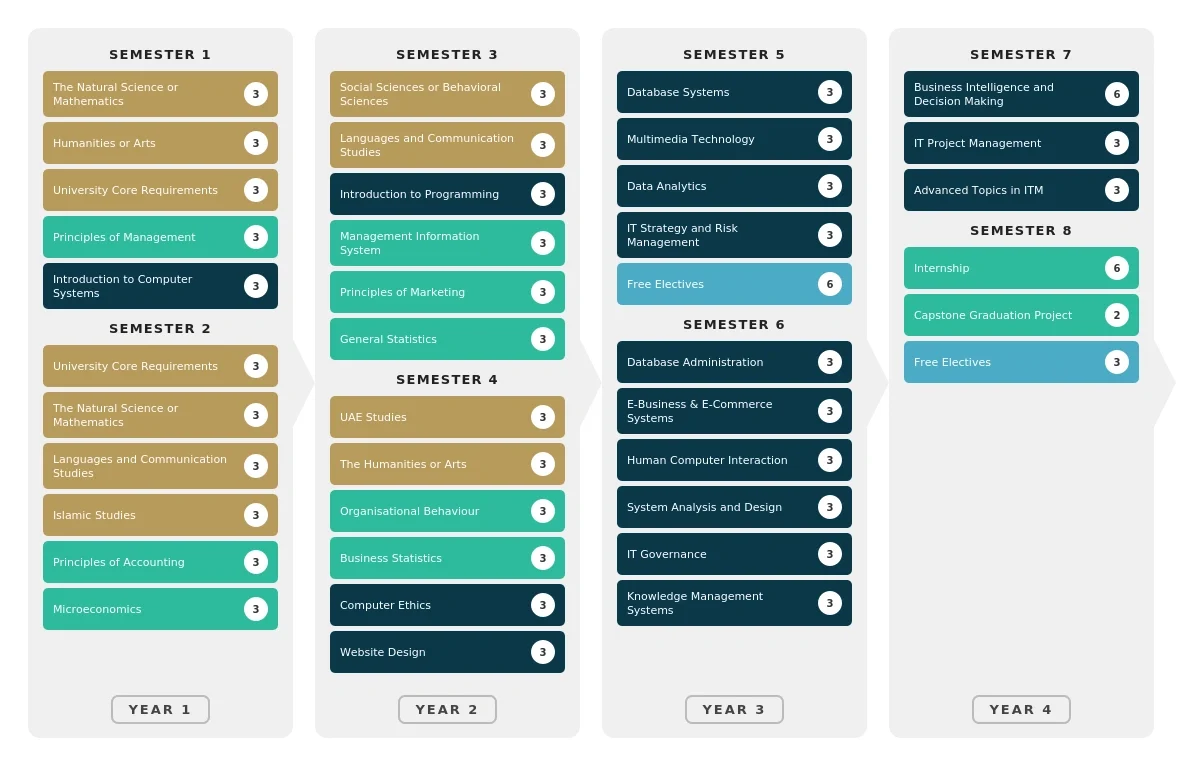
For undergraduate degree completion, undergraduate students must satisfy the following requirements:
1. Earn a minimum CGPA of 2.00 on a scale of 4.00.
2. Successfully complete all courses as described in the study plan.
3. The Degree Completion requirements must be met within the timeframe of the program.
4. Transfer students must successfully earn a minimum of 50% of the course credits for the program at AUE.


