


The College of Engineering and Technology’s innovative Network Security specialization program is offered to meet critical business environment needs, guided by industry trends, driven by technology, and constantly evolving. The demand for security specialists in the region is constantly growing.
The program focuses on the practical and theoretical dimensions of cyber security across a range of fundamental areas, such as network security, vulnerability assessment, information security, wireless devices security, business continuity, cloud security, and database security.
The emphasis of the program is to prepare students with the knowledge and skills necessary to secure LAN/WAN, computers, detect and analyze attacks and threats, respond to attacks, develop security policies, procedures, and standards.
The mission of the computer science program is to equip students with a robust foundation in computer science and information technology, preparing them for competitive careers and industry challenges. We aim to foster teamwork, ensuring our graduates can contribute significantly to organizational goals and demonstrate effective communication skills.
Our program emphasizes adherence to ethical and legal standards, encouraging responsible professional conduct. We are committed to promoting lifelong learning, enabling graduates to acquire advanced knowledge and skills, adapt to technological advancements, and address societal needs.


| Course Category | Total Number of Courses | Total Number of Credit Hours |
|---|---|---|
| General Education Courses | 10 | 30 |
| Core Courses | 26 | 81 |
| Specialization Courses | 5 | 15 |
| Total | 41 Courses | 126 Credit Hours |
| Course Name | Course Code | Credit Hours | Course Description |
|---|---|---|---|
| Academic Writing | ENG 101 | 3 | This course provides students with advanced writing skills in English so that they can successfully pursue their studies in various academic specializations. It helps students to develop, improve, and upgrade their writing and structure skills, and it also acquaints students with technical writing, research papers, and essays since brief research methods are applied in student projects and assignments. |
| Arabic Composition | ARLAA 105 | 3 | This course is designed to enable students to analyze multiple texts in various fields of knowledge. In order to be able to distinguish between texts despite their difference of contents, it also enables student to simulate those texts in a correct way, and to transform the information into skill and behavior. And since writing is an integrated building process, and that the building is affected by its parts, therefore student needs models, linguistic laws, planning, cohesion and goals including: news and inquiries, demand and influence of the recipient. |
| Arabic for Non Arab Speakers | ARLNA 100 | 3 | This course is based on the principle that "Education" is an accumulative task especially when it comes to language learning. This process undergoes specific stages to assist the non-Arabic speakers to reach the ultimate goal which is to acquire the required skills (listening, speaking, reading, writing) easily and accurately. To achieve this aim, text-based dialogues are provided as head start for the non-Arabic speakers to continue to the higher levels. The course also provides basic elements for reading, writing, dialogues, and listening to assist the learners to confidently interact with the Arab community |
| Communication Skills in Arabic | ARLAA 100 | 3 | This course is designed to enable the Arabic-speaking student with the necessary language skills, especially focusing on the steps of writing reports, official letters and systematic research. To achieve this, and to develop the student's abilities to understand correctly what he reads and listens, and to gain the ability to write articles, reports, meeting minutes and recommendations of conferences and seminars in a sound manner, the course was concerned with training the student in basic writing skills; such as multiple spelling rules, punctuation marks, paragraph system, and essay writing progressively. |
| Contemporary Arab Art | DES 104 | 3 | This course explores Arab art and aesthetics from the beginning of the twentieth century till date. The students will learn about the contemporary art and design movement in Arab countries, the expression of cultural identity, as well as the factors involved and changes in aesthetics from Islamic to Arabic art. They will also study and analyze the role of pioneer artists from various generations with emphasis on their influence on contemporary Arab art. |
| Emirati Studies (formerly UAE and GCC Society) | ASC 208 | 3 | The course is designed to introduce the UAE and GCC society with its historical background and uniqueness. It is aimed at enabling students to understand the specific features of the society along with its customs, traditions and lifestyle. The course will introduce the processes and the challenges of development as well as the future aspirations of the UAE and GCC Society. |
| English Literature | ENG 200 | 3 | This course will provide the students with a comprehensive overview of English literature in the United States. It will familiarize the students primarily with early Anglo-American writers and the different literary movements that took place in the United States. Today American literature includes many minority literary works, but the historical matrix remains Anglo-Saxon if we are to consider the dominant culture as the starting historical point. |
| Environmental Science | ASC 211 | 3 | The ‘Principles of Environmental Science’ course is designed to introduce the fundamental concepts of Environmental Science to undergraduate students. It includes topics from different areas of study such as ecology, biology, soil science and atmospheric science. The course aims at raising environmental awareness among students and providing them with the scientific knowledge and skills to identify, prevent and solve environmental problems. Additionally, it deals with ecological concepts, organism interactions, communities and ecosystems. The course focuses on key areas of population dynamics, biodiversity, human activities and the environment managed ecosystems, air quality, water and solid waste management. |
| General Mathematics | MAT 100 | 3 | This course is designed to develop a good understanding of the fundamental concepts of mathematics. It also stresses on crucial cognitive transferable skills such as the ability to think logically and concisely. Mastering this course will give students the confidence to go on and do further courses in mathematics and statistics. |
| History of Islamic Art | DES 105 | 3 | This course aims to focus on the evolution of Islamic Art through a chronological overview of various ?trends and approaches throughout history. Students will explore and analyze the rise and influence of ?Islam leading to the formation of a new artistic culture the world over.? |
| Innovation and Entrepreneurship | MGT 604 | 3 | This course marks students’ introduction to the theory and practice of innovation and entrepreneurship. Whether they are creating an opportunity or seizing an existing one students explore the core concepts and tools for creating new products or services, new businesses, or new markets from a multilayered perspective. The course examines the fundamentals of innovation in a multitude of settings, operationalizing the entrepreneurial spirit via a comprehensive business plan, and making decisions in the areas of strategic planning, financing, marketing, process improvement, and management with an awareness of the opportunities and challenges of working in an increasingly complex environment regionally and internationally. |
| Introduction to AI | ASC 219 | 3 | This course offers an introductory exploration of Artificial Intelligence (AI) for students across all disciplines. It focuses on applying AI concepts and tools practically without delving deeply into specialized or theoretical content. Students will learn basic AI concepts through practical exercises, including problem-solving, decision-making, simple machine learning, reinforcement learning, probabilistic learning, and natural language processing. The course will emphasize the impact of AI on society, ethics, and everyday life, preparing students to understand and engage with AI in various contexts. By the end of the course, students will have a comprehensive understanding of artificial intelligence, its branches, and practical applications across real-world domains |
| Introduction to Philosophy | ASC 201 | 3 | This course will introduce the students to the key concepts of philosophy and its principle tools. The course will discuss the schools of philosophical thought, and will apply philosophical analysis to the topics of knowledge, religion, mind, freedom, responsibility, and ethics. |
| Introduction to Research | ASC 207 | 3 | The intent of this course is two-fold. First, it introduces students with the basic research terminologies. Second, it familiarizes them with the process of research from choosing a topic to writing the proposal. Students will be immersed in hands on experience where they will be introduced to research concepts that will help them understand, interpret, and review a journal article. Contents to be covered include the language of research, types of research, elements of scientific research proposal, writing an academic research proposal using APA style, research ethics, identifying data collection instruments, and interpreting data. |
| Islamic Civilization | ASC 106 | 3 | The course is designed to give an in-depth understanding of the Islamic civilization. It deals with the universal principles that went into the making of the Islamic civilization. It examines the basic ideas of Islamic civilization besides exploring their contemporary relevance and challenges. The course seeks to effectively address the notion of the ‘clash of civilizations. |
| Islamic Culture | ASC 105 | 3 | This course will expand students’ knowledge to enable them to understand the Islamic culture and its characteristics. It analyzes the sources of legislation in Islam. It offers a review of the history of Islam and how it is currently the fastest growing religion in the world. |
| Middle East History | ASC 204 | 3 | This course provides an overview of Middle-Eastern History, including the sources of Middle Eastern History. The course will conclude with discussions about perspectives on Middle-Eastern History. |
| Natural Science | ASC 210 | 3 | The natural science course incorporates a wide range of subjects of sciences such as astronomy, geology, biology, chemistry, and environmental science. The course will present the scientific facts of astronomy, the Earth and its weather, water, and environment, biology, and nutrition with the chemicals of life. The course emphasizes understanding the core principles of different branches of science and their effects on our lives. Moreover, the course explores the scope of natural phenomena, changing environment conditions, general health rules of nutrition, and the variety of living organisms. The course helps the students to acquire skills in observation, critical thinking, analyzing, interpreting, understanding and discussing scientific terminology and facts. |
| Sustainable Energy | ASC 212 | 3 | This course gives a thorough introduction to sustainable energy, conservation, and energy efficiency within the UAE and the world. It will explore the relationship between energy, environment, economy and ecological well-being. It will discuss energy production from the biology, natural science, environmental science and social sciences perspectives. A variety of topics will be introduced including global warming, climate change, sustainable food production, solid waste management, environmental and natural resources laws. The course includes the growing challenges of climate change and energy crisis and proposes solutions to overcome them. |
| University Life | ASC 101 | 3 | The purpose of this course is to facilitate the process of transition into a new academic and cultural environment for the new students enrolled in the AUE. Furthermore, it aims to promote their confidence so that they can succeed and meet the academic requirements. The course assimilates academic content with interactive in class activities to ensure an understanding of curricular options and begin to develop a future career plan through self-reflection. |
| World History | ASC 203 | 3 | This course provides an overview of World / General History. The course will conclude with discussions about perspectives on World History. It surveys the history of humankind since 250CE till 1990 CE. In addition, interregional, comparative, cross-cultural, transnational, and historiographical topics will be considered. The objective of the course is to explore the roots of contemporary globalization and to develop historical thinking and writing. |
| Course Name | Course Code | Credit Hours | Course Description |
|---|---|---|---|
| Advanced Topics in Computer Science | CSC 412 | 3 | ?The course Advanced Topics in CS is designed to provide students with the current and emerging technologies relevant to Computer Science and Information Technology. The course aims at introducing the new advanced concepts, principles, and practices of the modern computing landscape. The course content might vary from one semester to another depending upon the emerging technologies, faculties expertise, and students’ preferences. Advanced Topics in CS course uses a variety of teaching strategies to expose students to real-world scenarios, which are current industry challenges. This approach ensures that CS graduates are equipped with the contemporary skill sets required in the ever-changing industry. The course enables students to explore distinct areas of CS, which are not covered in the regular coursework and focuses on the identification of long-term overall aims and interests, as well as the means of using CS to help businesses achieve their organizational goals. Topics covered in this course include but are not limited to, Blockchain, Data Science,?Machine Learning, Artificial Intelligence, and Big Data among others. This course aims at improving students’ soft and hard skills through assignments, oral presentations, and a final group-based project. |
| Artificial Intelligence | CET 470 | 3 | The course Artificial Intelligence (AI) begins with introducing the basic concepts of artificial intelligence and its risks and benefits. The course also covers problem-solving techniques using search, adversarial search, and game algorithms. Furthermore, the course deals with knowledge, inference, and planning, including first-order logic, knowledge representation, and instrumental planning. In addition, the course discusses uncertain knowledge, and reasoning including probabilistic reasoning, Bayesian networks, and simple decision-making. Finally, the course introduces the concept of machine learning. |
| Calculus 1 | MAT 110 | 3 | This course is an introduction to differential and integral calculus. It begins with a short review of basic concepts related to functions. Then it introduces the concept of a limit to a function. It then unfolds to the study of derivatives and their applications. Thereafter it considers the area problem and its solution, the definite integral. |
| Calculus II | MTH 102 | 3 | Students who have taken calculus I, can take this course to excel in the taught subjects. The course will tackle differentiation and integration in depth focusing on various applications and techniques of the aforementioned. Furthermore, the course will also attack modeling by differential equations, together with solving some type of these equations. |
| Capstone Graduation Project | CIT 416 | 3 | The objective of the capstone graduation project is to provide students with the application of knowledge, skills, and experience gained during their program of study to complete a project collaboratively depending on the student’s major and preference. The course assumes that students have identified the proposal from the previous capstone seminar course. The course expects students to implement and evaluate their proposals. For the IT Management student, the Capstone project will focus on the design, implementation, and evaluation of an IT system or solution that addresses a specific business problem or opportunity relevant to the student’s major and preferences. The project will culminate in the submission of a final report addressing the |
| Computer Architecture and Organization | CET 444 | 3 | This course discusses the main concepts of computer architecture and organization, such as the behavior and structure of different computer’s functional modules. Students will learn as well as how these functional modules interact to meet users’ processing needs. In addition, the course will introduce students to basic computer organization, data representation and computer arithmetic, digital components, digital logic circuits, register transfer, microprogrammed control, input-output organization, central processing unit, memory organization and pipelining. |
| Computer Ethics | CIT 307 | 3 | This interdisciplinary course provides students with a comprehensive understanding of ethics and its application in the field of Information Technology (IT). It covers the principles and concepts that form the foundation of ethics, with a focus on how these concepts impact IT professionals and users. The course explores ethical standards in IT, such as cyberattacks and cybersecurity, privacy, freedom of expression, intellectual property, ethical decisions in software development, social networking, and ethics of IT organizations. The course will be assessed through a variety of methods such as assignments, case studies, and a group-based final project that focuses on the specific ethical issues of information technology of students' interests. |
| Data Analytics | CIT 311 | 3 | Good data analytics is the basis for effective decisions. Whoever owns the data can quickly and efficiently extract the information needed to make informed decisions. The purpose of this course is to introduce students to the essential concepts, theories, methods, and tools related to data analytics. The aim of the course is to give students a thorough understanding of the concepts and procedures involved in data collection, processing, analysis, and visualization. The course is designed to empower students with the appropriate collection of formulas and techniques for data analytics. This course discusses how to use data analytics to improve decision-making and is ideal for those new to using data analytics to show how to expand their usage horizon. |
| Data Structures and Algorithms | BCE 212 | 3 | This course aims at providing students with a comprehensive understanding of the foundation of data structure and algorithms using Python as an implementation medium. The course aims to introduce the fundamental topics and techniques in data structure as the Analysis of algorithms and complexity, searching and sorting algorithms, and fundamental data structures. The course starts with a review of Python programming language, then the course moves to the analysis of algorithms and their complexity using Big-O notation to allow students to evaluate the performance of algorithms to select the most efficient algorithm for a given problem and to implement them using Python. The course exposes students to the fundamental linear and non-linear data structure and their applications including Stack, Queue, Deque, Linked list, Recursion and applications on recursion, Trees and Trees algorithms as binary search tree and its implementation, and finally graphs and graph algorithms as breadth and depth-first search algorithms. The course is heavily dependent on the implementation of the covered topics using Python. During the course, students will work on individual assignments and group-based final projects. |
| Database Systems | CIT 212 | 3 | This course provides essential knowledge for the design and implementation of relational databases. The course covers conceptual E-R modeling, logical, and physical design of relational databases as well as the principles and application of normalization. Students will learn database architecture and implementation by exploring Structured Query Language (SQL) and use it to access, manipulate and extract information from the database. Students will be involved in hands-on assessments to improve their skills in database design and implementation. Students will collaborate in a final group-based project to demonstrate their acquired knowledge. |
| Digital Logic and Design | CET 240 / CSC 201 | 3 | This course offers an introduction to electronic models with logic design and the basic concepts used in digital systems. The course covers the design and applications of combinational logic components and sequential circuits. The course includes details of how computer systems are developed by highlighting the basic concepts involved in computer theory like truth tables, binary arithmetic, and standard representation of logic functions. |
| Discrete Mathematics | MTH 200 | 3 | This course of discrete mathematics aims to introduce students to concepts, ideas, and techniques that are widely used in computer science. The goal of this course is to teach various topics in discrete mathematics that qualify students to think logically and mathematically to solve problems in computer science. To achieve this goal, students will study logic and proofs concepts, basic structures, set operations, functions, sequence and summations. Moreover, the following concepts constitute part of the course, as well: methods of proving theorems, induction and recursion, basic rules of counting, pigeonhole principles, permutation and combination, discrete probability, advance counting technique, graph terminology, Dijkstra’s algorithm, traveling salesman and trees. |
| Internship | CIT 305 | 2 | CET offers the internship course as a graduation requirement for students in both programs CS and ITM. This course designed to provide students with practical work experience in their field of study. The students in this course will be placed in different organizations where they must work on real-world projects under the supervision of experienced professionals, and they require to complete 480 working. The course also will include classroom sessions to discuss the theory and concepts related to the field of study. |
| Introduction to Computer System | CSC 110 | 3 | The purpose of this introductory course is to study computers and data. It gives an establishment to utilizing computers in different courses and educational module for research, correspondence, and writing. Students will be exposed to the fundamentals of hardware and its associated software and systems improvement. The course will show how the computer automates the processing of information. |
| Introduction to Operating Systems | CET 346 | 3 | This course covers the essential operating system concepts. The students will be provided an introduction to operating systems including a brief history of development through the years and the five managements under each operating system. The course will also cover the topics including processes and threads in context of resource management, memory management and related schemes, CPU scheduling algorithms and file systems. Several alternative algorithms related to page replacement policies and CPU scheduling are discussed along with understanding their advantages and disadvantages. The role of the device manager will be emphasized in the context of resource sharing. Other topics such as concurrent processes and synchronization, deadlocks and security are also presented briefly. Furthermore, the students will get hands-on practical labs on modern Operating Systems including Linux and Windows. The advanced labs will introduce the practice of a scripting language to understand the various topics presented through the course outline. |
| Introduction to Programming | CIT 201 | 3 | This course provides an introduction to computer programming using Python, assuming no prior programming experience. This course introduces students to the fundamentals of computational problem-solving, covering principles of logical thinking, algorithm-based problem-solving, and implementation using a programming language. The course emphasizes both concepts and practices. Students will learn problem-solving techniques, programming best practices, and coding skills. Topics covered include variables, assignment statements, input/output statements, selection, repetition, and functions. The course includes labs, assignments, midterm, and final exams to reinforce learning. Students will acquire practical, hands-on experience and collaborate on the group-based final project and through various laboratory activities conducted throughout the duration of the course. |
| Introduction to Statistics (formerly General Statistics) | MGT 105 | 3 | The General Statistics, an introductory course in statistics, discusses the following topics: an introduction to statistical methods; descriptive statistics; the normal distribution, basic techniques of statistical inference; confidence intervals and hypothesis tests for population means and proportions; a comprehensive introduction to probability, probability distributions and sampling. The course uses the software SPSS during laboratory sessions. |
| Linear Algebra | MTH 210 | 3 | In this course students will learn linear algebra and develop an appreciating on how the application of this branch of mathematics plays an important role in many computer science undertakings and help solving diverse problems in internet search, data mining, machine learning, graphic design, compilers, bioinformatics, relational database design, and database optimization. The course aims to improve the analytical thinking skills of students through their ability to understand the core principles of linear algebra, such as linear equations, matrices, vector spaces, coordinate systems, determinants, linear operators, linear transformations, eigenvalues, eigenvectors, orthogonality, and quadratic Forms, and then be able to apply these techniques to solve basic problems in IT. |
| Modern Programming Languages | CSC 315 | 3 | The course emphasizes the rationale for studying programming languages and the criteria to evaluate them. The concepts of language design, constructs and common design trade-offs will be discussed. Topics include syntax and semantics of languages, data types, names, bindings, scopes, expressions and assignment statements, control structures, subprograms, and their implementation. This course also covers advanced topics such as abstraction and concurrency support offered by Object-Oriented programming (OOP) language. Furthermore, the latest trends, such as functional and logic programming paradigm will be explained. Students will work on individual assessments and on a group-based project to evaluate the modern programming languages. |
| Network Essentials | BCE 200 / CSC 302 | 3 | This course is designed to provide a needed background to understand computer networks. It describes types of networks, how networking affects society, and the components and tools that are used to create networks in various business models. The course also introduces networking, offering easy-to-follow details on hardware, networking protocols, remote access, and security. New networking professionals will first learn what they need to know about network technology, and then how to apply that knowledge to set up, manage, and secure networks. |
| Object Oriented Programming | CET 210 | 3 | This course aims at introducing object-oriented programming (OOP) concepts and design principles, using Python programming language. The course aims to equip students with the fundamental knowledge and skills needed to develop software applications using OOP. The course covers abstraction, information hiding, classes, methods, attributes, inheritance, polymorphism, file processing, overloading, exception handling, reading, and writing from text files using Python’s built-in handling functions. The course includes hands-on exercises that will help students develop the skills required to develop Object-Oriented functioning programs to solve real-world computing problems. Students will collaborate with peers to deliver a functioning object-oriented program that applies the acquired knowledge through the course. |
| Physics 1 | PHY 100 | 3 | Physics course introduces the basic concepts, theories and terminologies of the scientific method in the |
| Physics 2 | PHY 200 | 3 | This course explores the physical concepts of electrostatics and electromagnetism. This subject benefits the students to develop sold background of the electricity and magnetism fundamentals. Topics include: electric charge, electric field, Coulomb’s law, Gauss’s law, electronic component such as resistors, capacitors and indicators, direct and alternative currents and various experiments that focused on the given topic. |
| Software Engineering | CSC 401 | 3 | This course aims to introduce the theoretical concepts and methodologies of software engineering to students. Students will gain a deep understanding of software processes, including process models, process activities, process improvement, and the challenges of coping with changing requirements The course also covers agile software development and agile methods, requirement engineering, system modelling, implementation, testing and evolution. Throughout the course, students will learn to use various diagramming techniques in Unified Modeling Language (UML) to design the artifacts needed for software development. . They will work collaboratively on a group-based project that applies the concepts, methods, and techniques learned throughout the course to model a real-world problem. |
| Theory of Computation | CSC 304 | 3 | The course provides a comprehensive introduction to computing theory, covering the fundamental principles and concepts. This course takes a mathematical approach to develop a comprehensive grasp of the subject by focusing on the formulation of theorems and proofs, regular expressions, Turing machines and their variants, decidable languages, the recursion theorem, and complexity theory are among the ideas covered in the course. Students will explore several concepts such as the equivalence of deterministic and non-deterministic finite automata and the conversions between pushdown automata and context-free grammar in order to design an effective and efficient parsing technique. The course will conclude with a discussion of non-computability and complexity, giving students a thorough understanding of the theoretical foundations of computation. |
| Website Design | CIT 205 | 3 | The purpose of this course is to provide essential knowledge for designing, developing, and maintaining a dynamic and interactive website. Coverage includes HTML, Cascading Style Sheets (CSS), Server-Side Scripting and JavaScript. This course introduces to students how to develop webpages and websites using different tools such as HTML editors and web browsers. They will learn how to write HTML code using different techniques. They will be taught to enhance the format of websites using styling and layout, to improve webpage look and feel through images, graphics, and tables, and to enrich audio, video, and multimedia files. Also, they will add interactivity to web pages by allowing developers to create animations and respond to user interactions. In addition, students will work in groups to create a website combining all the techniques they have learned throughout the semester. |
| Course Name | Course Code | Credit Hours | Course Description |
|---|---|---|---|
| Computer Security | CSCS 305 | 3 | The computer security course aims to provide students with a comprehensive understanding of the basic concepts and principles of computer security, including common security threats and attacks, user authentication, security policies, access control, encryption, malicious software, computer security technology, and operating system security. The course covers various security models and authentication mechanisms that are used to evaluate and apply security measures to computer systems. Students will learn to implement cryptographic techniques and design secure network architectures. They will also develop skills in securing software, including web applications and operating systems, by implementing effective strategies. Additionally, students will have the opportunity to collaborate with peers in a group project to analyze and address real-world computer security challenges |
| Ethical Hacking and Penetration Testing | CSCS 421 | 3 | The course is about ethical hacking and penetration testing, aims at introducing students to various tools and techniques used in these fields. Students will be able to identify vulnerabilities in a target network and make recommendations for improving network security by learning popular network scannings tools like Nmap and Nessus, vulnerability scanners like OpenVAS and Nikto, exploitation frameworks such as Metasploit, and network traffic analyzers like Wireshark. The course will also cover tools and techniques for password cracking, web application testing, and wireless network security testing. Moreover, students will collaborate in a group to implement security solutions that meet security needs. |
| Information Security | CSCS 303 | 3 | This course provides students with a comprehensive understanding of information security management systems (ISMS) and their implementation in organizations. The course covers topics such as evaluating security controls, aligning security needs with ISMS frameworks such as ISO, NIST,?and COBIT. Also implementing security controls to achieve confidentiality, integrity, and availability (CIA) and risk management, and applying continuous improvement principles for organizational security. Students will also have the opportunity to collaborate on a group project to design and implement an ISMS that meets security needs and adheres to standards and regulations. By the end of the course, students will be equipped with the knowledge and skills to effectively manage information security within an organization. |
| Mobile and Wireless Security (formerly Mobile Technology) | CSCS 401 | 3 | The course builds on prior knowledge gained in network essentials. The course introduces mobile technologies used for cellular communication. Topics covered include transmission fundamentals, protocols and the TCP/IP suite, antennas and propagation, coding and error control, satellite communications, mobile IP and Wireless Access Protocol and IEEE 802.11 Wireless LAN Standard. The main goal of the course is for students to learn and demonstrate knowledge of concepts, issues, tools, techniques and methods associated with mobile technologies and future trends in wireless communication. The course also provides hands-on introduction to write code for data communication over latest mobile and wireless networks. |
| Server Operating System and Network Management | ITM 306 | 3 | Students will learn about operating systems without getting into detail about internal algorithms. Case studies involving operating systems and networks are used by students to gain an understanding of how operating systems work and their role in Computers. The course covers structures of operating systems, processes and process synchronization, main memory, storage structure mass, file systems, operating system protection and security, virtual machine and UNIX flavours. Students learn to monitor, secure and configure an operating system using a UNIX flavours. |
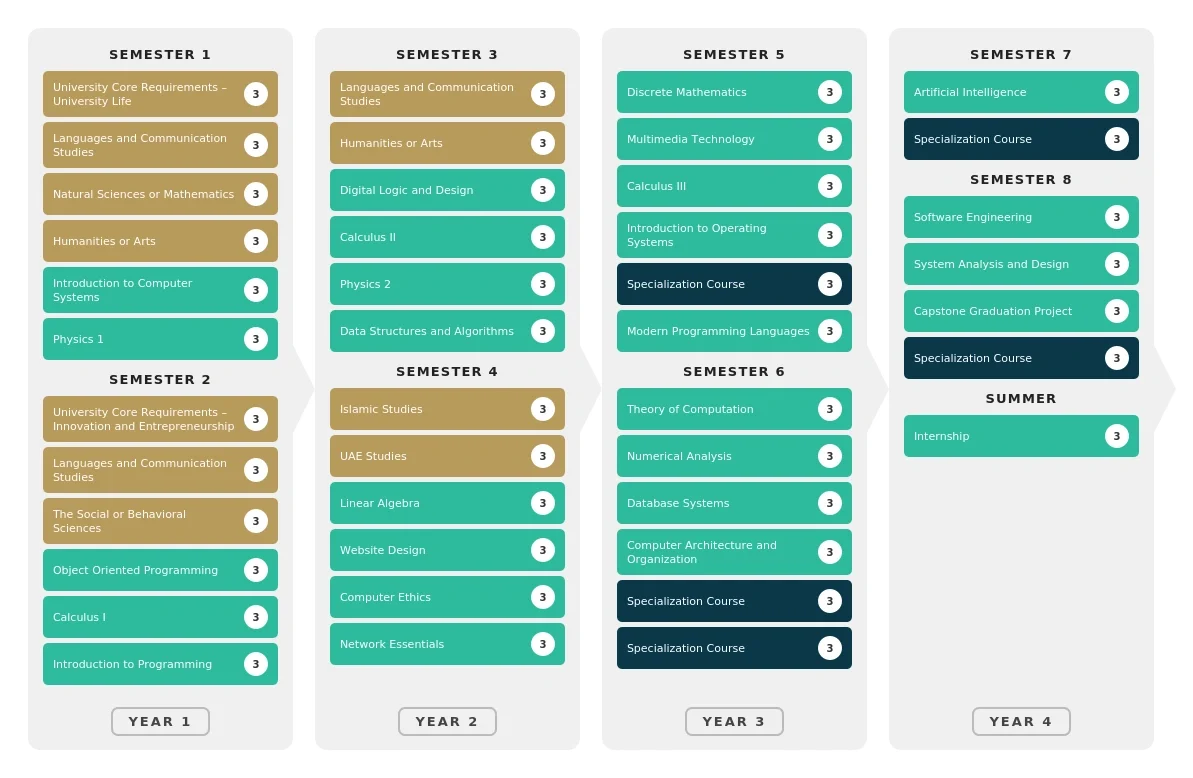
For undergraduate degree completion, undergraduate students must satisfy the following requirements:
1. Earn a minimum CGPA of 2.00 on a scale of 4.00.
2. Successfully complete all courses as described in the study plan.
3. The Degree Completion requirements must be met within the timeframe of the program.
4. Transfer students must successfully earn a minimum of 50% of the course credits for the program at AUE.


