

Program at a glance
Total Credit Hours
Duration
Instruction Language
Tuition Fees

AUE defines the undergraduate student retention rate as the percentage of first-year, full-time, degree-seeking undergraduate students enrolling in the Fall semester and returning in the following Fall semester.
| Cohort Year | Cohort Count | Retained to Next Fall | Retention % |
|---|---|---|---|
| Fall 2018–2019 | 8 | 5 | 63% |
| Fall 2019–2020 | 4 | 3 | 75% |
| Fall 2020–2021 | 1 | 1 | 100% |
| Fall 2021–2022 | 1 | 1 | 100% |
| Fall 2022–2023 | 1 | 1 | 100% |
| Fall 2023–2024 | 24 | 18 | 75% |
AUE defines the graduation rate for the undergraduate program as the ratio of the total number of completers within 150% of the normal time required for the program (6 years for undergraduate), divided by the number of students in the entering cohort.
| Cohort Year | Cohort Count | Graduated | Graduation % |
|---|---|---|---|
| Fall 2013–2014 | 1 | 0 | 0% |
| Fall 2014–2015 | 0 | 0 | – |
| Fall 2015–2016 | 5 | 3 | 60% |
| Fall 2016–2017 | 8 | 2 | 25% |
| Fall 2017–2018 | 5 | 4 | 80% |
| Fall 2018–2019 | 4 | 3 | 75% |
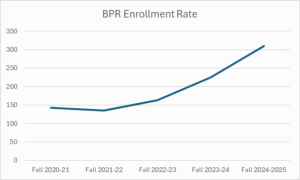
| Fall 2020-21 | Fall 2021-22 | Fall 2022-23 | Fall 2023-24 | Fall 2024-2025 |
|---|---|---|---|---|
| 143 | 135 | 163 | 225 | 310 |

Program Director
Assistant Professor / Acting Department Chair of Bachelors of Public Relations
| Course Category | Total Number of Courses | Total Number of Credit Hours |
|---|---|---|
| General Education Courses | 18 | 54 |
| Core Courses | 19 | 57 |
| Concentration Courses | 3 | 9 |
| Free Elective | 2 | 6 |
| Total | 42 Courses | 126 Credit Hours |
This course is designed to enable students to analyze multiple texts in various fields of knowledge. In order to be able to distinguish between texts despite their difference of contents, it also enables student to simulate those texts in a correct way, and to transform the information into skill and behavior. And since writing is an integrated building process, and that the building is affected by its parts, therefore student needs models, linguistic laws, planning, cohesion and goals including: news and inquiries, demand and influence of the recipient.
This course is based on the principle that "Education" is an accumulative task especially when it comes to language learning. This process undergoes specific stages to assist the non-Arabic speakers to reach the ultimate goal which is to acquire the required skills (listening, speaking, reading, writing) easily and accurately. To achieve this aim, text-based dialogues are provided as head start for the non-Arabic speakers to continue to the higher levels. The course also provides basic elements for reading, writing, dialogues, and listening to assist the learners to confidently interact with the Arab community
This course is designed to enable the Arabic-speaking student with the necessary language skills, especially focusing on the steps of writing reports, official letters and systematic research. To achieve this, and to develop the student's abilities to understand correctly what he reads and listens, and to gain the ability to write articles, reports, meeting minutes and recommendations of conferences and seminars in a sound manner, the course was concerned with training the student in basic writing skills; such as multiple spelling rules, punctuation marks, paragraph system, and essay writing progressively.
The course is designed to introduce the UAE and GCC society with its historical background and uniqueness. It is aimed at enabling students to understand the specific features of the society along with its customs, traditions and lifestyle. The course will introduce the processes and the challenges of development as well as the future aspirations of the UAE and GCC Society.
This course will provide the students with a comprehensive overview of English literature in the United States. It will familiarize the students primarily with early Anglo-American writers and the different literary movements that took place in the United States. Today American literature includes many minority literary works, but the historical matrix remains Anglo-Saxon if we are to consider the dominant culture as the starting historical point.
The ‘Principles of Environmental Science’ course is designed to introduce the fundamental concepts of Environmental Science to undergraduate students. It includes topics from different areas of study such as ecology, biology, soil science and atmospheric science. The course aims at raising environmental awareness among students and providing them with the scientific knowledge and skills to identify, prevent and solve environmental problems. Additionally, it deals with ecological concepts, organism interactions, communities and ecosystems. The course focuses on key areas of population dynamics, biodiversity, human activities and the environment managed ecosystems, air quality, water and solid waste management.
This course is designed to develop a good understanding of the fundamental concepts of mathematics. It also stresses on crucial cognitive transferable skills such as the ability to think logically and concisely. Mastering this course will give students the confidence to go on and do further courses in mathematics and statistics.
An introduction to the science of psychology, its theories and foundations. The course is focused on principles and research methodologies, including the following topics: history of psychology, the biology of mind, memory, learning, child and personality development, psychological disorders and therapy. The aim of the course is to introduce the basis of psychology, provide the foundational knowledge to pursue the subject in more depth in the future, and build an ongoing interest in the application of psychology in everyday life.
This course aims to focus on the evolution of Islamic Art through a chronological overview of various ?trends and approaches throughout history. Students will explore and analyze the rise and influence of ?Islam leading to the formation of a new artistic culture the world over.?
This course marks students’ introduction to the theory and practice of innovation and entrepreneurship. Whether they are creating an opportunity or seizing an existing one students explore the core concepts and tools for creating new products or services, new businesses, or new markets from a multilayered perspective. The course examines the fundamentals of innovation in a multitude of settings, operationalizing the entrepreneurial spirit via a comprehensive business plan, and making decisions in the areas of strategic planning, financing, marketing, process improvement, and management with an awareness of the opportunities and challenges of working in an increasingly complex environment regionally and internationally.
This course provides an understanding of anthropology, the study of human beings throughout time and space. Anthropology is a broad discipline that studies human from a holistic perspective looking at both biological and cultural aspects. Anthropologists use different methods in order to understand and study humans. During this course, students will experience ethnographic fieldwork.
This course will provide the students with a comprehensive overview of geography. Emphasis is on concepts that are necessary to understand global, regional and local issues. This course also includes topics on both human and physical geography.
This course will introduce the students to the key concepts of philosophy and its principle tools. The course will discuss the schools of philosophical thought, and will apply philosophical analysis to the topics of knowledge, religion, mind, freedom, responsibility, and ethics.
This course will introduce the students to the key concepts of Political Science and its principal tools. The course will discuss the role of main political actors in the field of politics and their function.
The intent of this course is two-fold. First, it introduces students with the basic research terminologies. Second, it familiarizes them with the process of research from choosing a topic to writing the proposal. Students will be immersed in hands on experience where they will be introduced to research concepts that will help them understand, interpret, and review a journal article. Contents to be covered include the language of research, types of research, elements of scientific research proposal, writing an academic research proposal using APA style, research ethics, identifying data collection instruments, and interpreting data.
This course serves as an introduction into the interdisciplinary and multifaceted social sciences. The content on the course covers the range of different disciplines that social sciences consists of, namely: anthropology, sociology, psychology, political science, economics and to a lesser extent also history and geography. The secondary aim of the course is moreover for students to develop their critical thinking skills by engaging actively with material about social issues, social change and social institutions.
This course introduces the science of Sociology. Students will examine Society, Institutions and the relationships that make up a social context. The scientific methodology used to study social interactions, stratification and other elements of sociological enquiry will be discussed to emphasize the core concept of sociology as a systematic study of societies and social structures.
The course is designed to give an in-depth understanding of the Islamic civilization. It deals with the universal principles that went into the making of the Islamic civilization. It examines the basic ideas of Islamic civilization besides exploring their contemporary relevance and challenges. The course seeks to effectively address the notion of the ‘clash of civilizations.
This course will expand students’ knowledge to enable them to understand the Islamic culture and its characteristics. It analyzes the sources of legislation in Islam. It offers a review of the history of Islam and how it is currently the fastest growing religion in the world.
This course provides an overview of Middle-Eastern History, including the sources of Middle Eastern History. The course will conclude with discussions about perspectives on Middle-Eastern History.
The natural science course incorporates a wide range of subjects of sciences such as astronomy, geology, biology, chemistry, and environmental science. The course will present the scientific facts of astronomy, the Earth and its weather, water, and environment, biology, and nutrition with the chemicals of life. The course emphasizes understanding the core principles of different branches of science and their effects on our lives. Moreover, the course explores the scope of natural phenomena, changing environment conditions, general health rules of nutrition, and the variety of living organisms. The course helps the students to acquire skills in observation, critical thinking, analyzing, interpreting, understanding and discussing scientific terminology and facts.
This course gives a thorough introduction to sustainable energy, conservation, and energy efficiency within the UAE and the world. It will explore the relationship between energy, environment, economy and ecological well-being. It will discuss energy production from the biology, natural science, environmental science and social sciences perspectives. A variety of topics will be introduced including global warming, climate change, sustainable food production, solid waste management, environmental and natural resources laws. The course includes the growing challenges of climate change and energy crisis and proposes solutions to overcome them.
The purpose of this course is to facilitate the process of transition into a new academic and cultural environment for the new students enrolled in the AUE. Furthermore, it aims to promote their confidence so that they can succeed and meet the academic requirements. The course assimilates academic content with interactive in class activities to ensure an understanding of curricular options and begin to develop a future career plan through self-reflection.
This course provides an overview of World / General History. The course will conclude with discussions about perspectives on World History. It surveys the history of humankind since 250CE till 1990 CE. In addition, interregional, comparative, cross-cultural, transnational, and historiographical topics will be considered. The objective of the course is to explore the roots of contemporary globalization and to develop historical thinking and writing.
Media and Mass Communication students are expected to complete a three-credit hour course on the Graduation Project. To be graduated, students must demonstrate that they have developed capability and proficiency in the core knowledge of their specialization and can show capability in learning aptitudes in the four specializations. It will be a challenging and thorough adventure however the reward for undertaking a significant experience is enormous and will without a doubt give AUE
graduates a capable begin in vocation they may pick. Moreover, English dialect and innovation capability should likewise be illustrated. The Capstone is ought to be as field-based contextual analyses. The Capstone Graduation Project is intended to give students a helpful working comprehension of the requirements and desires expected to move on from AUE.
Focuses on crisis management communication, the significance of crisis management in the age of digital and interactive media, ciris management stages and processes, crisis management team. Considerable attention will be placed on: Crisis communication preparation, developing a crisis management plan, crisis response strategies and role of social media during crisis.
The Integrated Marketing Communications course allows students to understand the basis of the marketing communication model, consumer behavior, and buyer persona decision-making process, underlying effective advertising and promotion activities. At the same time, knowledge, supported with numerous practical examples, allows students to understand how the above-mentioned variables interact to constitute a coherent, integrated, and synergic impact and final impact easily translated into profits.
This course provides students with an overview of international public relations through theories and models explaining international public relations, as well as planning based on scientific research, studying the effects of media and communication in international public relations, and discussing public relations experiences in this field such as America, Europe, Africa and the Middle East.
This course is provided to College of Media and Mass Communication’s students who completed 90 credit hours in the PR field under written agreements between the American University in the Emirates and potential training places in the UAE. The course serves as a continuous seminar that includes the professor, the student and the labor market. The student shall submit a comprehensive report to the respective supervisor on the experience acquired from the training and its importance to his/her future career at the end of the course.
This course introduces the students to the history of means of communication in the UAE and its evolution as it provides them with the basic knowledge needed to understand the media and cultural roles of communication entities and their organizational structures. Furthermore, the course helps the students acquire and develop the skills to understand and analyze the structure of press, radio and television organizations and the Emirates News Agency (WAM), in addition to the freedom of speech, legal frameworks and media legislation that determine the course of professional practice of old and new media. The course also provides the students with site visits to the headquarters of newspapers and broadcasting stations.
This course represents an introduction to the study of the public relations program where the student gains knowledge about the origins and development of public relations and its various models. The course allows students to understand the functions of public relations in planning, organizing and evaluating programs and campaigns conducted by public relations in the institution. The course focuses also on traditional means of communication and the Internet or tools of persuasion.
A practical applied course that works on providing the student
with knowledge and skills related to the basic framework for the preparation, design and production of printed, audio and visual media materials for the purposes of public relations for the organization, and to communicate with the public as well as building the organization’s reputation and mental image. The course also includes the foundations of preparing and designing publications and other public relations’ materials such as posters and brochures, magazines, newsletters, fold-outs, business cards, radio and television materials, advertisements and promotional gifts using modern technologies in preparation, design and production.
This optional course aims to introduce students to virtual public relations and the digital mechanisms used by public relations practitioners to achieve the institution’s goals, which include building the institution’s mental image and strategies in virtual public relations, creating digital content, maintaining the institution’s active presence on social networks and enhancing the institution’s interaction with its audience through promotional campaigns and audience research.
This course aims to provide the students with scientific knowledge about the methodologies for scientific research used in media and communication sciences, public relations, advertising, and recent trends in the scientific method. The course primarily focuses on the field, descriptive and analytical research, content analysis, polls, case studies, focus groups, practical application of the steps of scientific research and the development of applied research in the PR field.
The course is designed to equip students with knowledge and skills related to the concept of social marketing and the distinction between it and commercial marketing, social marketing models and theories, social marketing and building the mental image of the organization through social marketing programs that promote the organization’s social values and practices, and the importance of social marketing in the Internet age, in order to qualify them for planning and implementing marketing campaigns.
The course aims to teach students the fundamentals of public relations strategies and enrich them with the knowledge and skills necessary to understand and analyze strategic communication in organizations and public relations departments. Also, students will learn how to build strategies according to the established theories and professional ethics. The course will provide students with the skills needed to make appropriate decisions to manage organizations and public relations entities. It will also teach them how to deal with audiences and stakeholders.
The course provides a historical overview of the origins and evolution of the art of persuasion, and focuses mainly on explaining the models and theories of persuasion most applied in contemporary time for the purpose of providing students with the skills and competencies to apply persuasion strategies, methods and techniques to influence the audience, taking into account ethical values and standards.
Writing in public relations is designed to provide students with diverse professional strategies of writing in public, relations with a particular focus on communication objectives, techniques, strategies, styles, and mechanics. Building on students’ knowledge of the principles of public relations, the course provides practical, real-world writing experience within different formats for a wide range of audiences. The student’s critical thinking and writing skill are predicted to improve over their study.
The course aims to provide students with skills in applying the knowledge, models, theories and strategies of public relations in their practical and applied field of work after graduation, through case studies in public relations in the local framework in the UAE with global approaches for the purposes of self-development and with the aim of identifying the reality of the practice of public relations and how to deal with different issues in terms of applications and practice.
The technically-oriented course aims to teach the students digital photography skills and techniques through theoretical and practical training. The theoretical training helps students understand the definition of the photograph and how it’s created, in addition to learning the difference between traditional and digital photography. The practical training teaches the students how to use traditional and digital cameras and introduces them to the photo production process and computer software used to edit digital photos and print them for media and PR purposes.
This course introduces students to the basic concepts and principles of protocol arts and etiquette, and the rules governing meetings, conferences, diplomatic occasions and specific precedents. The course focuses in detail on providing students with the basic skills to implement protocol and etiquette.
The course includes various topics according to students’ interests and the emergence of new topics in the field of public relations that may appear in that field. The topics that may be included in the course, such as: modern communication technology and its impact on public relations and the media, the media and its role in business, and building its mental image. Social marketing and social responsibility for public relations in the organization. Applied public relations and many other topics.
Student must choose 2 courses/ 6 Credit Hours from different college /program/
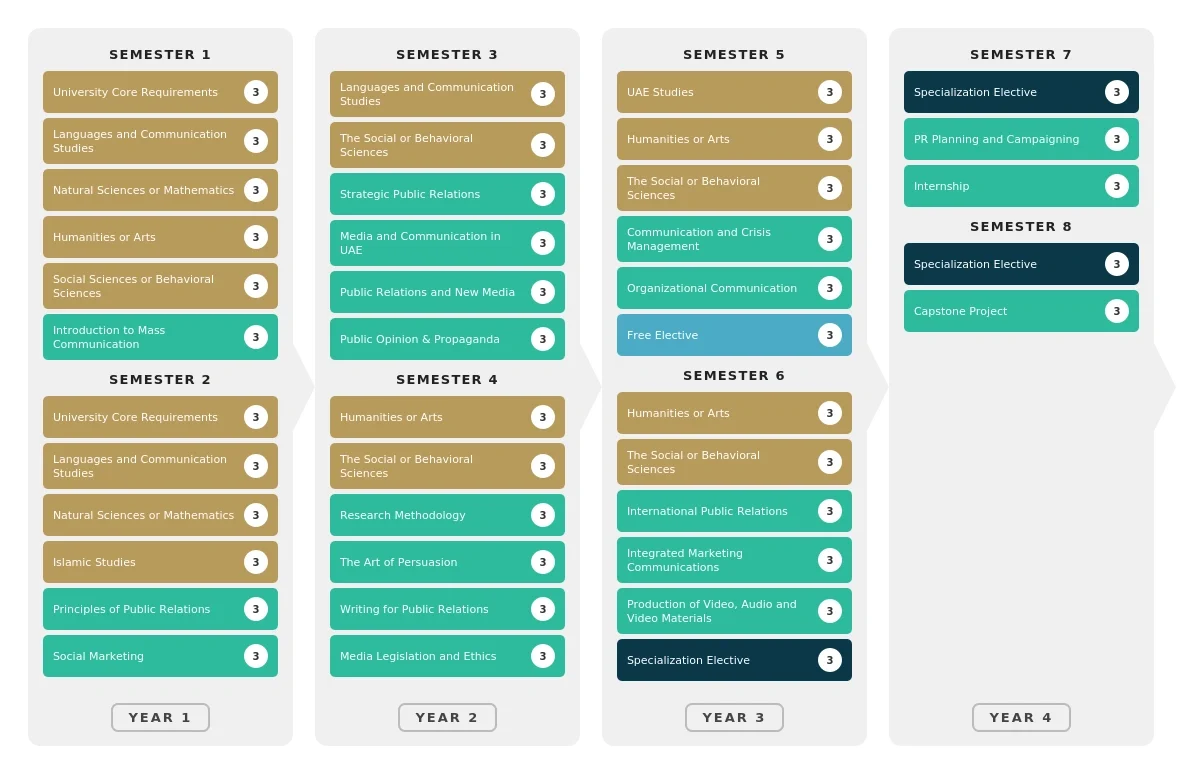
For undergraduate degree completion, undergraduate students must satisfy the following requirements:
When can I join?
Students can join at the beginning of any semester.
Intake 01
September
Min. 3 courses | 9 credit hours
Intake 02
January
Min. 3 courses | 9 credit hours
Intake 03
May
Min. 3 courses | 9 credit hours