


The Bachelor of Science in Mechatronics Engineering at AUE is a future-ready program tailored for those who dare to innovate and transform the world through intelligent systems. From autonomous drones and industrial robots to wearable technologies and smart manufacturing, the mechatronics revolution is redefining how we live, work, and interact with machines. This program empowers students to be at the heart of that transformation.
Through a curriculum that fuses mechanics, electronics, programming, control systems, and artificial intelligence, students gain interdisciplinary expertise essential for the design and optimization of modern, adaptive machines. But it’s not just about learning how things work — it’s about creating the next generation of technologies that will drive sustainable development, enhance quality of life, and solve real-world problems with ingenuity.
At AUE, we go beyond teaching the fundamentals of engineering. We empower our students to become innovators, integrators, and leaders in smart systems and automation. Here’s what sets our Mechatronics Engineering program apart:
If you’re passionate about engineering innovation, robotics, automation, and creating intelligent systems that move and interact with the world, then Mechatronics Engineering is your path. This program is ideal for problem-solvers, tech enthusiasts, and future engineers who seek to shape the future of technology.
To develop innovative, ethically grounded, and technically proficient mechatronics engineers capable of solving complex problems and advancing technology through interdisciplinary integration, hands-on experience, and lifelong learning.

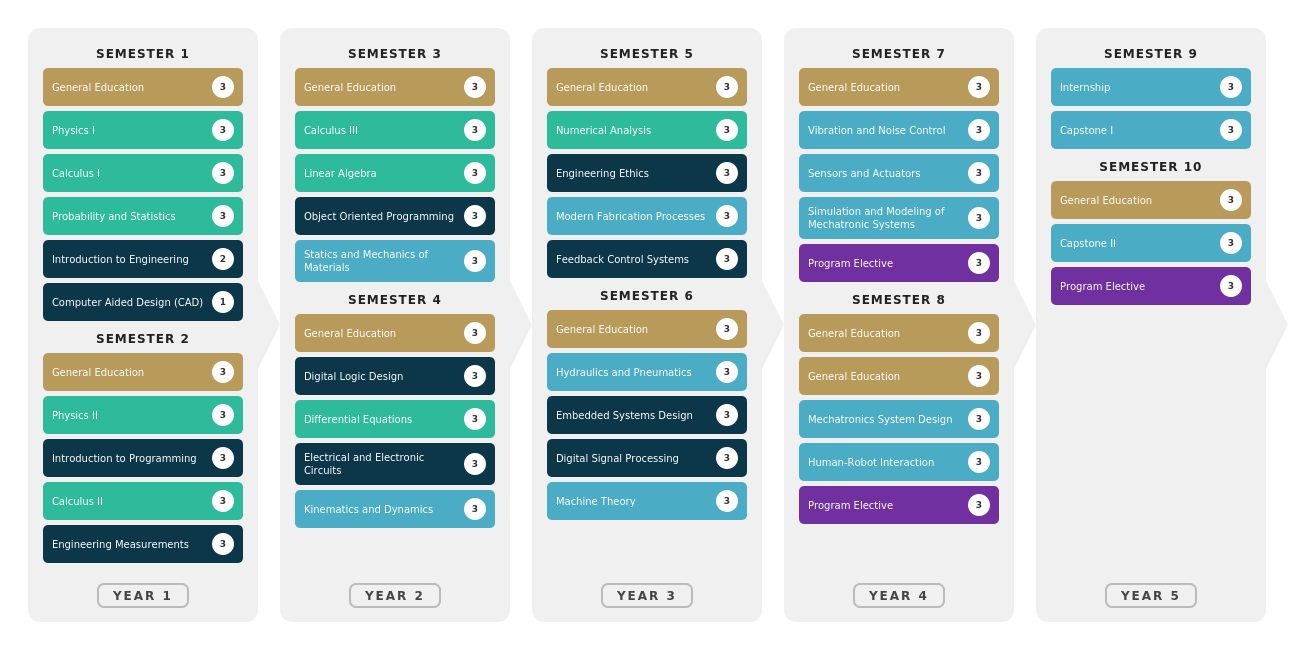
| Course Category | Total Number of Courses | Total Number of Credit Hours |
|---|---|---|
| General Education Courses | 10 | 30 |
| College Mathematics and Science Courses | 9 | 27 |
| Engineering Core | 10 | 30 |
| Mechatronics Engineering Core | 13 | 39 |
| Mechatronics Engineering Electives | 3 | 9 |
| Total | 45 | 135 Credit Hours |
| Course Name | Course Code | Credit Hours | Course Description |
|---|---|---|---|
| Academic Writing | ENG 101 | 3 | This course provides students with advanced writing skills in English so that they can successfully pursue their studies in various academic specializations. It helps students to develop, improve, and upgrade their writing and structure skills, and it also acquaints students with technical writing, research papers, and essays since brief research methods are applied in student projects and assignments. |
| Arabic Composition | ARLAA 105 | 3 | This course is designed to enable students to analyze multiple texts in various fields of knowledge. In order to be able to distinguish between texts despite their difference of contents, it also enables student to simulate those texts in a correct way, and to transform the information into skill and behavior. And since writing is an integrated building process, and that the building is affected by its parts, therefore student needs models, linguistic laws, planning, cohesion and goals including: news and inquiries, demand and influence of the recipient. |
| Arabic for Non Arab Speakers | ARLNA 100 | 3 | This course is based on the principle that "Education" is an accumulative task especially when it comes to language learning. This process undergoes specific stages to assist the non-Arabic speakers to reach the ultimate goal which is to acquire the required skills (listening, speaking, reading, writing) easily and accurately. To achieve this aim, text-based dialogues are provided as head start for the non-Arabic speakers to continue to the higher levels. The course also provides basic elements for reading, writing, dialogues, and listening to assist the learners to confidently interact with the Arab community |
| Communication Skills in Arabic | ARLAA 100 | 3 | This course is designed to enable the Arabic-speaking student with the necessary language skills, especially focusing on the steps of writing reports, official letters and systematic research. To achieve this, and to develop the student's abilities to understand correctly what he reads and listens, and to gain the ability to write articles, reports, meeting minutes and recommendations of conferences and seminars in a sound manner, the course was concerned with training the student in basic writing skills; such as multiple spelling rules, punctuation marks, paragraph system, and essay writing progressively. |
| Contemporary Arab Art | DES 104 | 3 | This course explores Arab art and aesthetics from the beginning of the twentieth century till date. The students will learn about the contemporary art and design movement in Arab countries, the expression of cultural identity, as well as the factors involved and changes in aesthetics from Islamic to Arabic art. They will also study and analyze the role of pioneer artists from various generations with emphasis on their influence on contemporary Arab art. |
| Emirati Studies (formerly UAE and GCC Society) | ASC 208 | 3 | The course is designed to introduce the UAE and GCC society with its historical background and uniqueness. It is aimed at enabling students to understand the specific features of the society along with its customs, traditions and lifestyle. The course will introduce the processes and the challenges of development as well as the future aspirations of the UAE and GCC Society. |
| English Literature | ENG 200 | 3 | This course will provide the students with a comprehensive overview of English literature in the United States. It will familiarize the students primarily with early Anglo-American writers and the different literary movements that took place in the United States. Today American literature includes many minority literary works, but the historical matrix remains Anglo-Saxon if we are to consider the dominant culture as the starting historical point. |
| Environmental Science | ASC 211 | 3 | The ‘Principles of Environmental Science’ course is designed to introduce the fundamental concepts of Environmental Science to undergraduate students. It includes topics from different areas of study such as ecology, biology, soil science and atmospheric science. The course aims at raising environmental awareness among students and providing them with the scientific knowledge and skills to identify, prevent and solve environmental problems. Additionally, it deals with ecological concepts, organism interactions, communities and ecosystems. The course focuses on key areas of population dynamics, biodiversity, human activities and the environment managed ecosystems, air quality, water and solid waste management. |
| General Mathematics | MAT 100 | 3 | This course is designed to develop a good understanding of the fundamental concepts of mathematics. It also stresses on crucial cognitive transferable skills such as the ability to think logically and concisely. Mastering this course will give students the confidence to go on and do further courses in mathematics and statistics. |
| History of Islamic Art | DES 105 | 3 | This course aims to focus on the evolution of Islamic Art through a chronological overview of various ?trends and approaches throughout history. Students will explore and analyze the rise and influence of ?Islam leading to the formation of a new artistic culture the world over.? |
| Innovation and Entrepreneurship | MGT 604 | 3 | This course marks students’ introduction to the theory and practice of innovation and entrepreneurship. Whether they are creating an opportunity or seizing an existing one students explore the core concepts and tools for creating new products or services, new businesses, or new markets from a multilayered perspective. The course examines the fundamentals of innovation in a multitude of settings, operationalizing the entrepreneurial spirit via a comprehensive business plan, and making decisions in the areas of strategic planning, financing, marketing, process improvement, and management with an awareness of the opportunities and challenges of working in an increasingly complex environment regionally and internationally. |
| Introduction to AI | ASC 219 | 3 | This course offers an introductory exploration of Artificial Intelligence (AI) for students across all disciplines. It focuses on applying AI concepts and tools practically without delving deeply into specialized or theoretical content. Students will learn basic AI concepts through practical exercises, including problem-solving, decision-making, simple machine learning, reinforcement learning, probabilistic learning, and natural language processing. The course will emphasize the impact of AI on society, ethics, and everyday life, preparing students to understand and engage with AI in various contexts. By the end of the course, students will have a comprehensive understanding of artificial intelligence, its branches, and practical applications across real-world domains |
| Introduction to Philosophy | ASC 201 | 3 | This course will introduce the students to the key concepts of philosophy and its principle tools. The course will discuss the schools of philosophical thought, and will apply philosophical analysis to the topics of knowledge, religion, mind, freedom, responsibility, and ethics. |
| Introduction to Research | ASC 207 | 3 | The intent of this course is two-fold. First, it introduces students with the basic research terminologies. Second, it familiarizes them with the process of research from choosing a topic to writing the proposal. Students will be immersed in hands on experience where they will be introduced to research concepts that will help them understand, interpret, and review a journal article. Contents to be covered include the language of research, types of research, elements of scientific research proposal, writing an academic research proposal using APA style, research ethics, identifying data collection instruments, and interpreting data. |
| Islamic Civilization | ASC 106 | 3 | The course is designed to give an in-depth understanding of the Islamic civilization. It deals with the universal principles that went into the making of the Islamic civilization. It examines the basic ideas of Islamic civilization besides exploring their contemporary relevance and challenges. The course seeks to effectively address the notion of the ‘clash of civilizations. |
| Islamic Culture | ASC 105 | 3 | This course will expand students’ knowledge to enable them to understand the Islamic culture and its characteristics. It analyzes the sources of legislation in Islam. It offers a review of the history of Islam and how it is currently the fastest growing religion in the world. |
| Middle East History | ASC 204 | 3 | This course provides an overview of Middle-Eastern History, including the sources of Middle Eastern History. The course will conclude with discussions about perspectives on Middle-Eastern History. |
| Natural Science | ASC 210 | 3 | The natural science course incorporates a wide range of subjects of sciences such as astronomy, geology, biology, chemistry, and environmental science. The course will present the scientific facts of astronomy, the Earth and its weather, water, and environment, biology, and nutrition with the chemicals of life. The course emphasizes understanding the core principles of different branches of science and their effects on our lives. Moreover, the course explores the scope of natural phenomena, changing environment conditions, general health rules of nutrition, and the variety of living organisms. The course helps the students to acquire skills in observation, critical thinking, analyzing, interpreting, understanding and discussing scientific terminology and facts. |
| Sustainable Energy | ASC 212 | 3 | This course gives a thorough introduction to sustainable energy, conservation, and energy efficiency within the UAE and the world. It will explore the relationship between energy, environment, economy and ecological well-being. It will discuss energy production from the biology, natural science, environmental science and social sciences perspectives. A variety of topics will be introduced including global warming, climate change, sustainable food production, solid waste management, environmental and natural resources laws. The course includes the growing challenges of climate change and energy crisis and proposes solutions to overcome them. |
| University Life | ASC 101 | 3 | The purpose of this course is to facilitate the process of transition into a new academic and cultural environment for the new students enrolled in the AUE. Furthermore, it aims to promote their confidence so that they can succeed and meet the academic requirements. The course assimilates academic content with interactive in class activities to ensure an understanding of curricular options and begin to develop a future career plan through self-reflection. |
| World History | ASC 203 | 3 | This course provides an overview of World / General History. The course will conclude with discussions about perspectives on World History. It surveys the history of humankind since 250CE till 1990 CE. In addition, interregional, comparative, cross-cultural, transnational, and historiographical topics will be considered. The objective of the course is to explore the roots of contemporary globalization and to develop historical thinking and writing. |
| Course Name | Course Code | Credit Hours | Course Description |
|---|---|---|---|
| Calculus 1 | MAT 110 | 3 | This course is an introduction to differential and integral calculus. It begins with a short review of basic concepts related to functions. Then it introduces the concept of a limit to a function. It then unfolds to the study of derivatives and their applications. Thereafter it considers the area problem and its solution, the definite integral. |
| Calculus II | MTH 102 | 3 | Students who have taken calculus I, can take this course to excel in the taught subjects. The course will tackle differentiation and integration in depth focusing on various applications and techniques of the aforementioned. Furthermore, the course will also attack modeling by differential equations, together with solving some type of these equations. |
| Calculus III | MTH 201 / MAT 300 | 3 | Students who have taken calculus II can take this course to excel in the taught subjects needed by computer scientists. The course will demonstrate the use of differential equation in mathematical and real-life modeling. In addition, parametric equations and polar coordinates will be tackled later in the course. Furthermore, students will learn various concepts of infinite sequences and series and apply them in different context. |
| Differential Equations | 3 | This course provides a comprehensive exploration of differential equations, covering both ordinary differential equations (ODES) and partial differential equations (PDEs). Students will delve into fundamental concepts such as first-order ODES, second and higher-order linear ODEs, and systems of ODEs. Additionally, the curriculum includes advanced topics like Laplace transforms, Fourier series, and selected applications in PDEs. Emphasis is placed on real-world problem-solving and engineering applications to ensure a practical understanding of the mathematical principles introduced in the course. |
|
| Linear Algebra | MTH 210 | 3 | In this course students will learn linear algebra and develop an appreciating on how the application of this branch of mathematics plays an important role in many computer science undertakings and help solving diverse problems in internet search, data mining, machine learning, graphic design, compilers, bioinformatics, relational database design, and database optimization. The course aims to improve the analytical thinking skills of students through their ability to understand the core principles of linear algebra, such as linear equations, matrices, vector spaces, coordinate systems, determinants, linear operators, linear transformations, eigenvalues, eigenvectors, orthogonality, and quadratic Forms, and then be able to apply these techniques to solve basic problems in IT. |
| Numerical Analysis | CSC 310 | 3 | Numerical analysis deals mainly with algorithms that apply numerical estimation to tackle mathematical Analysis problems. This course introduces to students, numerical algorithms as methods to develop solutions to prevalent problems articulated in different disciplines such as science, engineering, and mathematics. The emphasis is to make students understand the concepts of construction, application, and restrictions of numerical algorithms. The course includes numerical methods to solve equations, polynomial interpolation, differential and integration equations, analysis of numerical errors, and applications of these analyses. The course will provide hands-on skills through software/tools such as MATLAB to the students. |
| Physics 1 | PHY 100 | 3 | Physics course introduces the basic concepts, theories and terminologies of the scientific method in the |
| Physics 2 | PHY 200 | 3 | This course explores the physical concepts of electrostatics and electromagnetism. This subject benefits the students to develop sold background of the electricity and magnetism fundamentals. Topics include: electric charge, electric field, Coulomb’s law, Gauss’s law, electronic component such as resistors, capacitors and indicators, direct and alternative currents and various experiments that focused on the given topic. |
| Probability and Statistics | MTH 105 | 3 | This course provides a comprehensive introduction to the fundamental principles of statistics and their application in data analysis. Students will explore key concepts such as data collection, descriptive statistics, probability theories, random variables, sampling distributions, and hypothesis testing. The course also covers advanced topics like regression analysis, multiple regression, and analysis of variance. Throughout the course, students will develop skills in interpreting and analyzing statistical data, enabling them to draw meaningful conclusions and make informed decisions. By the end of the course, students will be equipped with a solid foundation in statistical methods, preparing them for practical data analysis in various fields. |
| Course Name | Course Code | Credit Hours | Course Description |
|---|---|---|---|
| Capstone I | BME 480 | 3 | This course prepares students for the final-year Capstone project by emphasizing project planning and preparation within the Mechatronics field. Students will identify a technical industry challenge, analyze it, and define both functional and non-functional requirements to propose an innovative, computing-based solution. Students will work in groups of 2-4 members to foster collaboration, and each group will be assigned an academic supervisor and an external industry practitioner to guide topic selection, ensuring alignment with industry needs and student interests. Throughout the course, groups will collaboratively develop a comprehensive project proposal that includes objectives, a literature review, research design, intellectual property considerations, as well as budget and schedule management. The course culminates in a group proposal defense conducted in an oral format, with individual contributions assessed through reflective papers documenting each student's involvement and learning experiences. Emphasizing project management, teamwork, collaboration, and presentation skills, this course equips students with the practical skills necessary to tackle real-world challenges in the field of Mechatronics. |
| Capstone II | BME 482 | 3 | Capstone II is a continuation of Capstone I and serves as the culminating experience for students. This course focuses on the design, development, and implementation of a comprehensive mechatronic system that addresses real-world challenges identified in Capstone I. Students will build upon the knowledge and skills acquired in the previous course, emphasizing interdisciplinary learning that integrates mechanical design, electronics, software development, and system integration in robotics. Working in teams, students will simulate professional engineering environments to deliver a functional prototype, accompanied by thorough documentation and analysis. The course emphasizes project management, collaboration, and the application of ethical considerations in engineering practices, preparing students to present their final projects in a professional context. By the end of the course, students will demonstrate their ability to effectively communicate technical concepts and deliver innovative mechatronic solutions. |
| Human-Robot Interaction | BME 442 | 3 | Human-Robot Interaction is an advanced course that delves deep into the world of robots and the innovative technology of sensory feedback and haptic interfaces in robotics. This course involves the theoretical coverage of the topics as well as hands-on laboratory activities to reinforce the learning. This course will provide students with an in-depth understanding of how collaborative robots work alongside human workers in various industrial and service settings, and how sensory feedback and haptic interfaces enhance human-robot interaction. Students will explore the design, operation, and application of robots, as well as the principles and development of sensory feedback systems in robotic technology. It prepares students for the dynamic field of automation and robotics across various industries. |
| Hydraulics and Pneumatics | BME 322 | 3 | This course provides a comprehensive study of fluid power systems, focusing on both hydraulic and pneumatic applications. Students will explore the principles of fluid mechanics, including fluid statics, viscosity, and pressure measurement, as well as dynamic concepts like the continuity and energy equations and Bernoulli’s equation. The course covers the selection and analysis of key fluid power components such as pumps, motors, valves, and accumulators. Through hands-on lab and project exercises, students will design and troubleshoot fluid power circuits, applying flow and pressure control techniques to meet specific operational needs. Emphasis is placed on teamwork and collaborative problem-solving to develop practical solutions to real-world challenges in hydraulics and pneumatics. By the end of the course, students will be equipped with the skills needed to design, implement, and optimize fluid power systems for diverse applications. |
| Internship | BME 492 | 3 | The Mechatronics Engineering Internship program is a critical component for graduation, designed to bridge the gap between academic theories and real-world applications in the field. Students are required to engage in practical work experience, applying their robotics engineering skills in a professional environment. During the internship, students are expected to submit four detailed reports, documenting their tasks, the skills they applied, and the new competencies they developed. The program culminates with an oral presentation, where students reflect on their overall performance, challenges faced, and the knowledge gained throughout their internship experience. |
| Kinematics and Dynamics | BME 212 | 3 | This course provides an in-depth exploration of the principles of dynamics, focusing on the motion and forces associated with particles and rigid bodies. Students will learn to apply Newton’s laws, analyze particle and rigid body kinematics, and evaluate mechanical systems using work-energy and impulse-momentum methods. The course also covers mechanical vibrations, including natural frequencies and damping. Emphasizing both individual analysis and teamwork, students will collaborate on projects to model and simulate dynamic systems, gaining hands-on experience with tools like MATLAB. By the end of the course, students will be equipped with the analytical skills needed to solve complex dynamics problems in engineering contexts. |
| Machine Theory | BME 324 | 3 | This course provides a comprehensive exploration of the theory and applications of electrical machines, focusing on magnetic circuits, transformers, and both synchronous and induction machines. Students will learn the principles of magnetic circuits, transformer construction, and phasor diagrams, along with three-phase transformer connections and practical considerations. The course covers operating principles, performance analysis, and control techniques for synchronous and induction machines, including torque-speed characteristics and speed control methods. Additionally, the course introduces special machines such as stepper motors and brushless DC motors. Emphasizing both theoretical knowledge and hands-on lab work, students will also collaborate in teams to design, analyze, and present innovative machine solutions. By the end of the course, students will be equipped with essential skills to understand, operate, and optimize a variety of electrical machines. |
| Mechatronics System Design | BME 462 | 3 | This course provides a comprehensive understanding of mechatronics system design, focusing on the integration of mechanical, electronic, and computational components into unified systems. Students will explore fundamental concepts of mechatronics, including system modeling, simulation techniques, and the design of various transducers. The curriculum emphasizes practical skills in designing, analyzing, and controlling complex mechatronic systems. Key topics include electromechanical, electrostatic, and piezoelectric transducers, as well as digital control systems and feedback mechanisms. The course also addresses system robustness, uncertainty, and performance evaluation, with a strong focus on hands-on lab work and team-based projects that culminate in a final presentation. By the end of the course, students will be proficient in developing and optimizing mechatronic systems, prepared for real-world engineering challenges. |
| Modern Fabrication Processes | BME 330 | 3 | The course provides an introduction to the resources needed for designing and fabricating mechatronics systems, including CAD/CAM/CAE; NC machining, casting, 3-D printing and additive manufacturing, injection molding, laser cutting; PCB layout and fabrication; sensors and actuators; analog instrumentation; embedded digital processing. Emphasis is placed on learning how to use the tools as well as understanding how they work. The course also has a laboratory or hands-on component where the students get the opportunity of hands-on learning of the various fabrication techniques and their use. |
| Sensors and Actuators | BME 426 | 3 | This course introduces the fundamental principles, types, and applications of various sensors and actuators. It covers sensor signal processing, smart sensors, IoT integration, actuator control systems, and emerging trends in sensor technology. Students will engage in hands-on laboratory activities to integrate these components with microcontrollers, emphasizing the role of communication protocols in sensor and actuator networks. |
| Simulation and Modeling of Mechatronic Systems | BME 366 | 3 | This course introduces the principles of modeling and simulation for mechatronic systems, covering mechanical, electrical, and control subsystems. Students will learn to develop mathematical models and simulate the behavior of these systems using modern tools. The course emphasizes multi-domain system integration and control strategies, preparing students to analyze and optimize mechatronic systems. Team-based projects will develop collaboration skills as students work to solve real-world engineering problems. |
| Statics and Mechanics of Materials | BME 210 | 3 | This course provides students with a thorough understanding of the principles of statics and the mechanics of deformable materials. The course covers essential concepts such as force systems, equilibrium, stress, and strain, leading to advanced topics including torsion, bending, and material failure criteria. Through a combination of theoretical instruction, practical activities, and individual projects, students will apply their knowledge to real-world engineering problems. By the end of the course, students will be equipped to analyze and design structural elements while ensuring they meet safety and performance standards in various engineering applications, effectively communicating their findings. |
| Vibration and Noise Control | BME 416 | 3 | This course focuses on both theoretical principles and practical techniques to manage and mitigate vibrations and noise in engineering systems. Students will learn foundational concepts, including single and two-degree-of-freedom systems, progressing to advanced topics like modal analysis and experimental techniques. The course emphasizes teamwork in real-world applications, such as designing vibration isolation systems and implementing noise control measures. Topics include rotating machinery vibrations, active vibration control, acoustics, structural damping, and automotive noise control, delivered through hands-on labs and collaborative projects. |
| Course Name | Course Code | Credit Hours | Course Description |
|---|---|---|---|
| Computer Aided Design (CAD) | CET 103 | 1 | This hands-on laboratory course is dedicated to developing practical skills in Computer-Aided Drawing (CAD). Students will navigate industry-standard CAD software to create and manipulate both 2D and 3D drawings. Special emphasis is placed on engineering applications, ensuring students gain a comprehensive understanding of industry standards. Through a combination of theoretical knowledge and practical exercises, students will develop proficiency in utilizing CAD tools effectively. The course aims to bridge theoretical concepts with real-world applications, empowering students to apply CAD techniques to engineering problems. |
| Digital Logic and Design | CET 240 / CSC 201 | 3 | This course offers an introduction to electronic models with logic design and the basic concepts used in digital systems. The course covers the design and applications of combinational logic components and sequential circuits. The course includes details of how computer systems are developed by highlighting the basic concepts involved in computer theory like truth tables, binary arithmetic, and standard representation of logic functions. |
| Digital Signal Processing | 3 | This course introduces students to the fundamental concepts and applications of digital signal processing (DSP). It covers discrete-time signals and systems, Z-transforms, and frequency domain analysis using Fourier techniques. Students will explore the Discrete Fourier Transform (DFT), Fast Fourier Transform (FFT), and the design and implementation of digital filters (FIR and IIR). Practical exercises using MATLAB allow students to apply these concepts in real-world DSP applications. The course also explores advanced topics such as adaptive filters and real-time DSP systems, with a focus on teamwork for final projects. |
|
| Electrical and Electronic Circuits | 3 | This course provides a comprehensive introduction to electric and electronic circuits, blending theory with hands-on labs. Students will analyze circuits using fundamental laws and advanced techniques such as nodal and mesh analysis. The course covers AC circuits, semiconductor devices like diodes, BJTs, and FETs, and operational amplifiers. Circuit simulation tools are also introduced to enhance design and analysis skills. Collaborative teamwork in labs and projects is emphasized, preparing students to apply their knowledge to real-world circuit challenges. |
|
| Embedded Systems Design | 3 | This course provides a comprehensive introduction to the principles and practices of embedded systems design. Students will explore key concepts such as embedded system architecture, real-time operating systems (RTOS), sensor and actuator interfacing, communication protocols, memory management, and power optimization techniques. The course emphasizes both theoretical understanding and practical implementation, with hands-on lab work involving microcontrollers, peripherals, and debugging tools. Throughout the course, students will work in teams to design, implement, and present a complete embedded system project, integrating real-time requirements, communication protocols, and power management strategies. By the end of the course, students will be equipped with the knowledge and skills to design and troubleshoot embedded systems used in various industries. |
|
| Engineering Ethics | 3 | Engineering Ethics is an essential course that introduces the principles and applications of ethics in engineering. It covers the fundamental theories of ethics, historical perspectives, and their relevance in modern engineering practice. The course explores the role of ethical decision-making in various engineering contexts, including emerging technologies, environmental sustainability, and workplace dynamics. Students will engage with case studies and real-world scenarios to understand the application of professional codes of ethics and the ethical implications of engineering decisions. |
|
| Engineering Measurement | CET 104 | 3 | This course introduces the principles and techniques of both electrical and mechanical measurements, focusing on the design, implementation, and analysis of measurement systems. Students will learn key concepts such as signal characteristics, uncertainty analysis, and data acquisition while gaining hands-on experience with tools like sensors, actuators, and data acquisition systems. Emphasis is placed on practical problem-solving and teamwork, with a final project where students design and present a comprehensive solution that integrates electrical and mechanical measurement principles, preparing them for mechatronics engineering challenges. |
| Feedback Control Systems | 3 | This course introduces the fundamental principles of feedback control systems. Students will explore both the theoretical and practical aspects of control system design, including system modeling, time and frequency domain analysis, and stability evaluation. Topics covered include transfer functions, state-space representation, steady-state error analysis, root locus techniques, and frequency response methods. Through hands-on projects and lab exercises, students will develop the skills to analyze and design feedback control systems that meet specific performance and stability criteria. The course emphasizes real-world applications of control systems and fosters teamwork through a final project, where students collaborate to design and implement a control system solution. |
|
| Introduction to Engineering | CET 101 | 2 | This is an introductory course designed to provide a comprehensive foundation in engineering for first-year students across disciplines. It introduces fundamental engineering principles, the engineering design process, problem-solving techniques, ethics, sustainability, and computational tools like CAD and Excel. Students work in teams on practical projects, enhancing their communication, collaboration, and presentation skills. This course bridges theory and application, preparing students for future technical courses and real-world engineering challenges. |
| Introduction to Programming | CIT 201 | 3 | This course provides an introduction to computer programming using Python, assuming no prior programming experience. This course introduces students to the fundamentals of computational problem-solving, covering principles of logical thinking, algorithm-based problem-solving, and implementation using a programming language. The course emphasizes both concepts and practices. Students will learn problem-solving techniques, programming best practices, and coding skills. Topics covered include variables, assignment statements, input/output statements, selection, repetition, and functions. The course includes labs, assignments, midterm, and final exams to reinforce learning. Students will acquire practical, hands-on experience and collaborate on the group-based final project and through various laboratory activities conducted throughout the duration of the course. |
| Object Oriented Programming | CET 210 | 3 | This course aims at introducing object-oriented programming (OOP) concepts and design principles, using Python programming language. The course aims to equip students with the fundamental knowledge and skills needed to develop software applications using OOP. The course covers abstraction, information hiding, classes, methods, attributes, inheritance, polymorphism, file processing, overloading, exception handling, reading, and writing from text files using Python’s built-in handling functions. The course includes hands-on exercises that will help students develop the skills required to develop Object-Oriented functioning programs to solve real-world computing problems. Students will collaborate with peers to deliver a functioning object-oriented program that applies the acquired knowledge through the course. |
| Course Name | Course Code | Credit Hours | Course Description |
|---|---|---|---|
| Artificial Intelligence | CET 470 | 3 | The course Artificial Intelligence (AI) begins with introducing the basic concepts of artificial intelligence and its risks and benefits. The course also covers problem-solving techniques using search, adversarial search, and game algorithms. Furthermore, the course deals with knowledge, inference, and planning, including first-order logic, knowledge representation, and instrumental planning. In addition, the course discusses uncertain knowledge, and reasoning including probabilistic reasoning, Bayesian networks, and simple decision-making. Finally, the course introduces the concept of machine learning. |
| Industrial Automation and Control Systems | BME 424 | 3 | This comprehensive course focuses on the core aspects of Industrial Automation and Control Systems (IACS). Starting with an introduction to the field, students explore sensors and actuators, progressing to the in-depth study of Programmable Logic Controllers (PLCs), their programming languages, and logic design. The course extends to cover Supervisory Control and Data Acquisition (SCADA), Human-Machine Interface (HMI) design, and various industrial communication protocols. As the course progresses, students explore advanced topics such as Distributed Control Systems (DCS), Safety Instrumented Systems (SIS), and cybersecurity in the context of industrial automation. |
| Industrial Robotics | BME 444 | 3 | This course provides an in-depth exploration of advanced robotics concepts, focusing on the design, analysis, and implementation of robotic systems. Students will engage with topics such as robot kinematics, dynamics, control strategies, and programming languages. Emphasizing practical applications, the course includes hands-on projects and simulations to develop skills in robotics system design and implementation. Ethical considerations and the impact of robotics in society will also be discussed, preparing students for future challenges in the field. |
| Mechatronic System Reliability and Maintenance | BME 466 | 3 | This course delves into the essential principles of ensuring the reliability and maintenance of mechatronic systems, which are crucial for maintaining peak performance in a wide range of industrial applications. It begins with an introduction to the fundamentals of mechatronic system reliability, followed by a comprehensive examination of failure modes and root cause analysis. Students will participate in hands-on labs that cover reliability testing, modeling exercises, and the fundamentals of both preventive and corrective maintenance. As the course advances, students will tackle more complex topics, such as reliability-centered maintenance (RCM), condition monitoring, and risk-based maintenance strategies, all reinforced with practical lab sessions. Additionally, the course will cover maintenance planning, scheduling, and the impact of human factors on system reliability and maintenance, using real-world case studies to bring theory into practice. |
| Path Planning and Navigation | BME 446 | 3 | This course focuses on the principles and techniques of path planning and navigation for autonomous robots. The course covers motion planning algorithms, sensor integration, and localization methods, emphasizing practical applications in dynamic environments. Students will engage in simulations and hands-on activities to develop skills in implementing efficient navigation strategies. Topics include multi-robot coordination, energy management, and the challenges of operating in unknown environments. This course prepares students for real-world applications in robotics and autonomous systems. |
| Renewable Energy Systems | BME 470 | 3 | This comprehensive course covers the principles and technologies behind various renewable sources. Starting with solar energy, students focus on both photovoltaic and solar thermal systems. The course extends to wind energy, hydropower, geothermal energy, and biomass energy systems. The course examines the integration of these sources and explores sustainable energy planning, policies, and energy storage. |
Graduates of the BSME program are equipped to take on diverse roles, including:


