THE STORY-TELLING OF FINANCIAL INFORMATION
Accounting is the most sought-after area of interest for many business graduates. This is challenging, as one learns to be right on top of the financial markets; the program allows conducting analysis and observes the improvement of financial situations. Above all, graduates with accounting qualifications are the benchmark of success for any company. Therefore, it is imperative to know that this degree opens doors to gain prestigious qualifications and practice as a Chartered Accountant or Certified Public Accountant. In the last two decades, the globalization phenomenon has seen the growth of networks in both the private and public sectors. This has tremendously experienced the appropriate means of fiscal management at the micro and macro level. Thus, the window of opportunity encourages fresh graduates to learn and practice fiscal management, budget allocation, cost-effectiveness, investment and financial opportunities, and many other options. This is a versatile area that can link to any discipline for an aspiring employee backed with a solid foundation of accounting knowledge.
PROFESSIONAL BODY ACCREDITATION
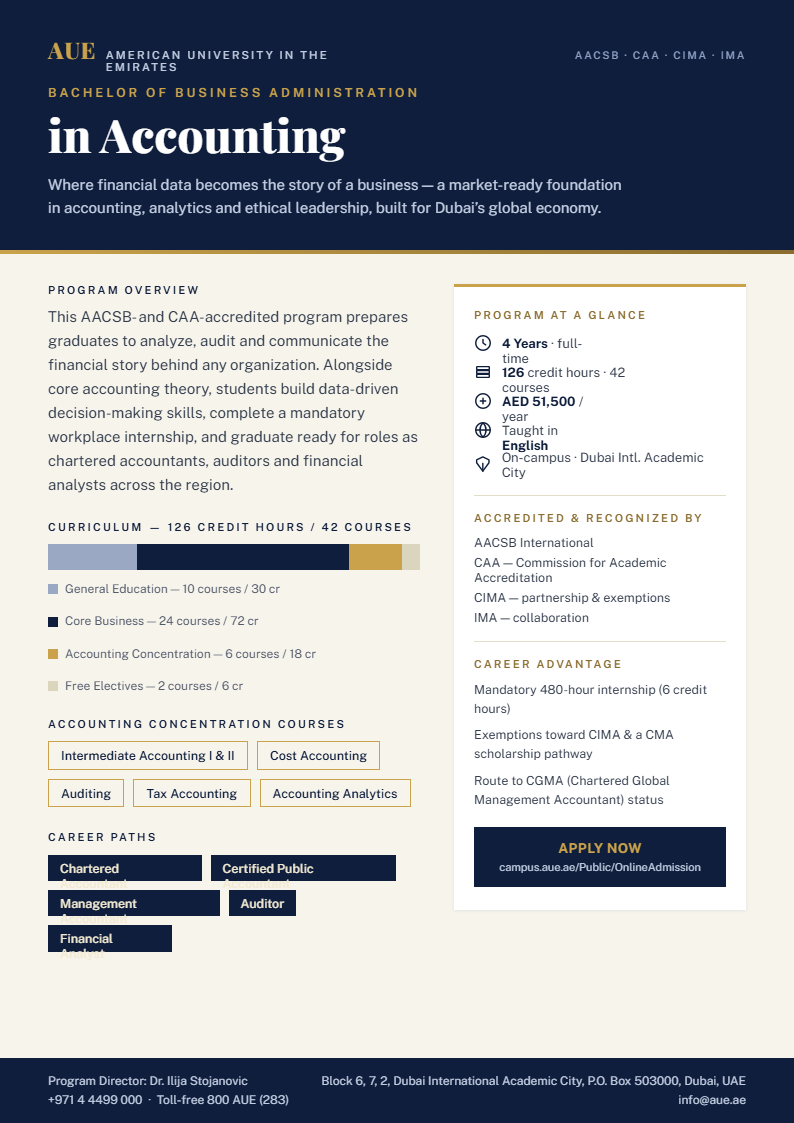
College of Business Administration Curriculum received International Accreditation by Chartered Institute of Management Accountants (CIMA). CIMA has partnered with AICPA (American Institute of CPAs), and the merger-now named AICPA-Association of International Certified Professional Accountants is the world’s largest professional body of management accountants. The accreditation resulted in several COBA concentrations attaining equivalency and exemptions from CIMA that will ensure graduating market-ready students. Students can benefit from these exemptions and attain the elite CGMA Chartered Global Management Accountant certification. COBA has also collaborated with the Institute of Management Accountants (IMA) to get Certified Management Accountant (CMA) scholarships for its students.


| Course Category | Total Number of Courses | Total Number of Credit Hours |
|---|---|---|
| General Education Courses | 10 | 30 |
| Core Courses | 24 | 72 |
| Concentration Courses | 6 | 18 |
| Free Elective | 2 | 6 |
| Total | 42 Courses | 126 Credit Hours |
| Course Name | Course Code | Credit Hours | Course Description |
|---|---|---|---|
| Communication Skills in Arabic | ARLAA 100 | 3 | This course is designed to enable the Arabic-speaking student with the necessary language skills, especially focusing on the steps of writing reports, official letters and systematic research. To achieve this, and to develop the student's abilities to understand correctly what he reads and listens, and to gain the ability to write articles, reports, meeting minutes and recommendations of conferences and seminars in a sound manner, the course was concerned with training the student in basic writing skills; such as multiple spelling rules, punctuation marks, paragraph system, and essay writing progressively. |
| English Literature | ENG 200 | 3 | This course will provide the students with a comprehensive overview of English literature in the United States. It will familiarize the students primarily with early Anglo-American writers and the different literary movements that took place in the United States. Today American literature includes many minority literary works, but the historical matrix remains Anglo-Saxon if we are to consider the dominant culture as the starting historical point. |
| Introduction to Philosophy | ASC 201 | 3 | This course will introduce the students to the key concepts of philosophy and its principle tools. The course will discuss the schools of philosophical thought, and will apply philosophical analysis to the topics of knowledge, religion, mind, freedom, responsibility, and ethics. |
| Arabic for Non Arab Speakers | ARLNA 100 | 3 | This course is based on the principle that "Education" is an accumulative task especially when it comes to language learning. This process undergoes specific stages to assist the non-Arabic speakers to reach the ultimate goal which is to acquire the required skills (listening, speaking, reading, writing) easily and accurately. To achieve this aim, text-based dialogues are provided as head start for the non-Arabic speakers to continue to the higher levels. The course also provides basic elements for reading, writing, dialogues, and listening to assist the learners to confidently interact with the Arab community |
| Introduction to Anthropology | ASC 102 | 3 | This course provides an understanding of anthropology, the study of human beings throughout time and space. Anthropology is a broad discipline that studies human from a holistic perspective looking at both biological and cultural aspects. Anthropologists use different methods in order to understand and study humans. During this course, students will experience ethnographic fieldwork. |
| Introduction to Geography | ASC 206 | 3 | This course will provide the students with a comprehensive overview of geography. Emphasis is on concepts that are necessary to understand global, regional and local issues. This course also includes topics on both human and physical geography. |
| Emirati Studies (formerly UAE and GCC Society) | ASC 208 | 3 | The course is designed to introduce the UAE and GCC society with its historical background and uniqueness. It is aimed at enabling students to understand the specific features of the society along with its customs, traditions and lifestyle. The course will introduce the processes and the challenges of development as well as the future aspirations of the UAE and GCC Society. |
| Middle East History | ASC 204 | 3 | This course provides an overview of Middle-Eastern History, including the sources of Middle Eastern History. The course will conclude with discussions about perspectives on Middle-Eastern History. |
| Introduction to Social Sciences | ASC 110 | 3 | This course serves as an introduction into the interdisciplinary and multifaceted social sciences. The content on the course covers the range of different disciplines that social sciences consists of, namely: anthropology, sociology, psychology, political science, economics and to a lesser extent also history and geography. The secondary aim of the course is moreover for students to develop their critical thinking skills by engaging actively with material about social issues, social change and social institutions. |
| Introduction to Political Science | ASC 202 | 3 | This course will introduce the students to the key concepts of Political Science and its principal tools. The course will discuss the role of main political actors in the field of politics and their function. |
| General Mathematics | MAT 100 | 3 | This course is designed to develop a good understanding of the fundamental concepts of mathematics. It also stresses on crucial cognitive transferable skills such as the ability to think logically and concisely. Mastering this course will give students the confidence to go on and do further courses in mathematics and statistics. |
| Introduction to Sociology | ASC 104 | 3 | This course introduces the science of Sociology. Students will examine Society, Institutions and the relationships that make up a social context. The scientific methodology used to study social interactions, stratification and other elements of sociological enquiry will be discussed to emphasize the core concept of sociology as a systematic study of societies and social structures. |
| World History | ASC 203 | 3 | This course provides an overview of World / General History. The course will conclude with discussions about perspectives on World History. It surveys the history of humankind since 250CE till 1990 CE. In addition, interregional, comparative, cross-cultural, transnational, and historiographical topics will be considered. The objective of the course is to explore the roots of contemporary globalization and to develop historical thinking and writing. |
| History of Islamic Art | DES 105 | 3 | This course aims to focus on the evolution of Islamic Art through a chronological overview of various ?trends and approaches throughout history. Students will explore and analyze the rise and influence of ?Islam leading to the formation of a new artistic culture the world over.? |
| University Life | ASC 101 | 3 | The purpose of this course is to facilitate the process of transition into a new academic and cultural environment for the new students enrolled in the AUE. Furthermore, it aims to promote their confidence so that they can succeed and meet the academic requirements. The course assimilates academic content with interactive in class activities to ensure an understanding of curricular options and begin to develop a future career plan through self-reflection. |
| Academic Writing | ENG 101 | 3 | This course provides students with advanced writing skills in English so that they can successfully pursue their studies in various academic specializations. It helps students to develop, improve, and upgrade their writing and structure skills, and it also acquaints students with technical writing, research papers, and essays since brief research methods are applied in student projects and assignments. |
| Introduction to Research | ASC 207 | 3 | The intent of this course is two-fold. First, it introduces students with the basic research terminologies. Second, it familiarizes them with the process of research from choosing a topic to writing the proposal. Students will be immersed in hands on experience where they will be introduced to research concepts that will help them understand, interpret, and review a journal article. Contents to be covered include the language of research, types of research, elements of scientific research proposal, writing an academic research proposal using APA style, research ethics, identifying data collection instruments, and interpreting data. |
| Innovation and Entrepreneurship | INV 200 | 3 | Innovation is the engine of opportunity and acting as a catalyst, this course is intended to ignite an interest in innovation and inspire entrepreneurial action. At the core of innovation and entrepreneurship is a commitment to experiential learning that will encourage students to engage in critical thinking, and creative problem-solving while also equipping them with the soft skills needed in their pursuit of academic and professional endeavors. Students will discuss the relevance and role of innovation and entrepreneurship in work and life situations; determine opportunities for creative disruption and design a strategy for its implementation; develop a practical understanding of innovation through thoughtful debate and exercises, and demonstrate critical thinking and individual insight with a personal mastery portfolio. The course will be practically driven by including several workshops to equip the student with practical skills in developing innovative business ideas |
| Environmental Science | ASC 211 | 3 | The ‘Principles of Environmental Science’ course is designed to introduce the fundamental concepts of Environmental Science to undergraduate students. It includes topics from different areas of study such as ecology, biology, soil science and atmospheric science. The course aims at raising environmental awareness among students and providing them with the scientific knowledge and skills to identify, prevent and solve environmental problems. Additionally, it deals with ecological concepts, organism interactions, communities and ecosystems. The course focuses on key areas of population dynamics, biodiversity, human activities and the environment managed ecosystems, air quality, water and solid waste management. |
| Islamic Culture | ASC 105 | 3 | This course will expand students’ knowledge to enable them to understand the Islamic culture and its characteristics. It analyzes the sources of legislation in Islam. It offers a review of the history of Islam and how it is currently the fastest growing religion in the world. |
| Natural Science | ASC 210 | 3 | The natural science course incorporates a wide range of subjects of sciences such as astronomy, geology, biology, chemistry, and environmental science. The course will present the scientific facts of astronomy, the Earth and its weather, water, and environment, biology, and nutrition with the chemicals of life. The course emphasizes understanding the core principles of different branches of science and their effects on our lives. Moreover, the course explores the scope of natural phenomena, changing environment conditions, general health rules of nutrition, and the variety of living organisms. The course helps the students to acquire skills in observation, critical thinking, analyzing, interpreting, understanding and discussing scientific terminology and facts. |
| Sustainable Energy | ASC 212 | 3 | This course gives a thorough introduction to sustainable energy, conservation, and energy efficiency within the UAE and the world. It will explore the relationship between energy, environment, economy and ecological well-being. It will discuss energy production from the biology, natural science, environmental science and social sciences perspectives. A variety of topics will be introduced including global warming, climate change, sustainable food production, solid waste management, environmental and natural resources laws. The course includes the growing challenges of climate change and energy crisis and proposes solutions to overcome them. |
| Islamic Civilization | ASC 106 | 3 | The course is designed to give an in-depth understanding of the Islamic civilization. It deals with the universal principles that went into the making of the Islamic civilization. It examines the basic ideas of Islamic civilization besides exploring their contemporary relevance and challenges. The course seeks to effectively address the notion of the ‘clash of civilizations. |
| Arabic Composition | ARLAA 105 | 3 | This course is designed to enable students to analyze multiple texts in various fields of knowledge. In order to be able to distinguish between texts despite their difference of contents, it also enables student to simulate those texts in a correct way, and to transform the information into skill and behavior. And since writing is an integrated building process, and that the building is affected by its parts, therefore student needs models, linguistic laws, planning, cohesion and goals including: news and inquiries, demand and influence of the recipient. |
| General Psychology | ASC 200 | 3 | An introduction to the science of psychology, its theories and foundations. The course is focused on principles and research methodologies, including the following topics: history of psychology, the biology of mind, memory, learning, child and personality development, psychological disorders and therapy. The aim of the course is to introduce the basis of psychology, provide the foundational knowledge to pursue the subject in more depth in the future, and build an ongoing interest in the application of psychology in everyday life. |
| Course Name | Course Code | Credit Hours | Course Description |
|---|---|---|---|
| Principles of Accounting | ACC 100 | 3 | This principle-level course introduces students to the fundamentals of accounting terms, rules, concepts, procedures, and systems. Topics covered include the art of recording, classifying, and analyzing the data into useful information for both internal and external users. Students are introduced to the double-entry accounting concepts, general journals, and the accounting cycle. |
| Strategic Management | MGT 405 | 3 | This course captures the complexity of the current business environment and offers contemporary concepts and skills that enable students to design cutting-edge strategies through skill-building exercises. Furthermore, it benefits attendees to gain the necessary knowledge to manage consistent higher organizational performance by reading, analyzing, and designing a suitable working environment. Different models and tools in the course are practically applicable to find out the strengths and weaknesses of organizations; this analysis finally helps students design effective strategies and a strategic plan for the business. |
| Project Management | MGT 402 | 3 | This course provides intensive coverage of fundamental project management concepts and behavioral skills needed to successfully manage projects through the entire project life cycle. It provides mastering soft and hard skills to prepare students for a future career in project management. The course covers different project management domains, tailoring projects, project management methods, and project artifacts. It is focused on understanding the practical application of the project management body of knowledge. In this course, students explore project management with a practical approach through class exercises. |
| Introduction to Statistics (formerly General Statistics) | MGT 105 | 3 | The General Statistics, an introductory course in statistics, discusses the following topics: an introduction to statistical methods; descriptive statistics; the normal distribution, basic techniques of statistical inference; confidence intervals and hypothesis tests for population means and proportions; a comprehensive introduction to probability, probability distributions and sampling. The course uses the software SPSS during laboratory sessions. |
| Introduction to Business Risk Management | MGT 208 | 3 | "Introduction to Business Risk Management" is a foundational course offering students a |
| Business Technology Management | MGT 206 | 3 | This course offers a strategic exploration of the relationship between business and technology, |
| Internship | BBA 430 | 6 | An internship experience is an effective means to bridge the gap between theory and practice. The students |
| Business Intelligence and Analytics | MGT 316 | 3 | This course introduces the students to the fundamental principles of Business Intelligence (BI) and Business |
| Startup Management and Growth Strategies | MGT 318 | 3 | This course is designed to develop essential skills for effective startup management, with a specific |
| Business Statistics and Quantitative Analysis | MGT 207 | 3 | This course is designed to provide a foundational understanding of key statistics and quantitative |
| Managerial Accounting | ACC 105 | 3 | This is an introductory level course and introduces the concepts of management accounting. It involves accounting as a tool for planning and managing; students are acquainted with techniques and understand how relevant accounting information is used for effective operational planning and decision-making. |
| International Business | MGT 400 | 3 | The course International Business places emphasis on the global business scenario and the interrelationship between governments and businesses across borders. Further, it studies the economic dynamics between countries and regions. The course provides a detailed insight into the international monetary system, international trade, and foreign direct investment. The basic objective of the course is to provide an understanding of the global economy and the major issues related to the business environment. This course is generally "macro" in its composition, which is developed to provide intellectual focus with emphasis on the overriding theories best describing the International Business scenario. |
| Macroeconomics | ECO 200 | 3 | In this course, students are introduced to fundamental economic concepts relating to aggregate economic interactions, including national income accounting, aggregate supply and aggregate demand, unemployment, inflation, economic growth, fiscal and monetary policies, and international trade. This course emphasizes the fundamental components of total spending and the determination of the equilibrium income level and how a government might impact the state of the economy. |
| Sustainable Business Practices in the GCC and MENA Region (formerly Business Practice in UAE and GCC) | MGT 302 | 3 | The course aims to familiarize the student with various sustainability concepts at three levels: individual, organizational, and societal (Triple bottom line). The course will provide methods for measuring business' social, economic, and environmental impacts and the reporting standards to promote transparency. It equips the students with insight into how new technologies are used to solve sustainability issues. The course analyzes how companies adapt sustainability in marketing, operations, and supply chain management. It further creates solutions for effective and efficient management of operations by providing an understanding of how to navigate the tensions between pursuing sustainability initiatives and optimizing business performance. |
| Business Law | MGT 301 | 3 | This course familiarizes students with critical legal concepts that are an integral part of the decision-making process for a business entity to operate effectively in the United Arab Emirates. Students will identify and examine legal and regulatory risks inherent in different businesses from the standpoints of various stakeholders. The course is designed to equip students with knowledge and skills to remediate potential legal liability in the context of the UAE legal and regulatory environment affecting the law of business organizations, contract law, agency law, employment law, and torts. The course aims to develop students’ analytical reasoning skills through the interpretation of hypothetical scenarios, cases, and actual court decisions. The course methodology is grounded in class discussions, written analysis, and active learning exercises designed to strengthen students’ critical thinking and problem-solving skills. |
| Negotiation Skills | MGT 305 | 3 | Negotiation is an interactive process between two or more parties working together to determine a mutually agreeable solution to an issue of shared interest or mutual dispute. For better and smooth functioning, negotiation is vital in public and private sector organizations. Effective negotiation can ensure business success, but ineffective negotiation can weaken a company. This course introduces students to best practices and core negotiation concepts, including coalitions; communication; distributive bargaining; ethics, strategy, and planning; integrative negotiation; international and cross-cultural negotiation; complex negotiations; perception, cognition, and emotion; power and influence; relationships, and roles. Students will work individually and in groups on assessments, including case studies, discussions, in-class exercises, and presentations to increase their understanding of the curriculum in an academic and practical context. |
| Production and Operations Management | MGT 300 | 3 | The course aims to interpret the basic theories and practices in production and operations management. The course equips the students with the necessary skills and utilization of tools and techniques for effective and efficient management of operations. It further provides skills to the students for better decision-making and problem-solving in any industrial scenario. |
| Organizational Behavior | MGT 205 | 3 | Organizational behavior studies the influence of individuals, groups, and work culture on behavior within organizations; its chief goal is to improve an organization’s effectiveness. This course introduces students to the core concepts of organizational behavior including attitudes, emotions, and moods; communication; conflict and negotiation; diversity; group behavior and work teams; individual decision making; leadership and power; motivation; organization culture and structure; organizational change; and personality and values. |
| Principles of Management | MGT 100 | 3 | This course marks students’ first journey into the discipline of management. The focus of this course is to expose students to the fundamentals of the four functions of management of planning, organizing, leading and controlling. Within each function students are introduced to a multitude of managerial areas of focus including decision-making, organizational structure, power and politics, leadership, teams, motivation, and communication. |
| Principles of Marketing | MKT 200 | 3 | Principles of Marketing shows students how to create vibrant, interactive communities of consumers who make products and brands an integral part of their daily lives. To help them master this key challenge, this course provides the fundamentals of marketing within an innovative customer-value framework. In this course, students will learn how to create customer value and engagement in order to capture value in return. |
| Microeconomics | ECO 100 | 3 | This course is designed to introduce students to basic microeconomics concepts relating to individual decision-making. The course exposes students to the meaning, nature, and methods of studying Microeconomics. The concepts of supply, demand, and elasticity are used to analyze the behaviors of consumers and firms in different types of markets. The main topics covered include consumer behavior, firm production costs, pure competition, monopolistic competition, monopoly, and oligopoly. |
| Financial Management | FIN 200 | 3 | This course examines the financial strategic and operational decisions in organizations. It aims to provide the decision maker with the financial theory, concepts, and tools necessary to make better financial managerial decisions as well as enable the student to make sound decisions regarding financial analyses and judgments performed by others. |
| Human Resource Management | HRM 300 | 3 | This is an introductory course for HRM specialization that will help students acquaint themselves with the roles and functions of HRM. Students will analyze different HR trends and challenges from both an employee's and an employer's perspective. This course challenges students to recognize, understand, and apply HRM concepts and functions. Furthermore, it helps students enhance their HR skills through the use of case studies, in-class assignments, project discussions, and the development of necessary analytical and critical thinking skills required to understand the problems that HR managers face and handle them responsibly. |
| Course Name | Course Code | Credit Hours | Course Description |
|---|---|---|---|
| Cost Accounting | ACC 300 | 3 | This course introduces to the students the techniques used by cost accountants in the organizations. Further, it covers several approaches include cost control and product costing which assist in managerial decision making. The main topics of the course include cost accounting concepts, job orders, process costing, cost allocation, customer profitability, variance analysis, allocation of joint cost and support department costs, pricing decisions, and cost management. |
| Auditing | ACC 400 | 3 | This course aims at introducing the basic concepts, standards and procedures necessary for carrying out an external audit. Emphasis is laid on the Audit of the Financial Statements, the resulting outcome and how to form an opinion based on ethical and legal aspects |
| Accounting Analytics | ACC 302 | 3 | As organizations deal with massive amount of different types of data, the accountants need to use analytics to generate and communicate insights and recommendations that are date-driven to the decision makers. The accounting system should be able to identify the decision being made and the data required to create alternative solutions. The accounting analytics course is intended to prepare the students to be familiar with the advances in the filed of the accounting in terms data analytics, enabling them to critically think how to utilize the financial accounting and auditing data for decision making. The course will cover the following main areas in data analytics: Transforming data to into workable data set, using data visualization in data analysis, and communication of analysis results. |
| Intermediate Accounting I | ACC 200 | 3 | Intermediate Accounting I is the first course in a two-course sequence with a focus on the continued study of the accounting and reporting processes within the framework of accounting theory. Main topics include in-depth analysis of IFRS (International Financial Reporting Standards), accounting theory, and requirements for publicly owned corporations. The course is targeted towards undergraduate accounting and finance specializations and focuses on the importance of preparing, analyzing, and communicating business information in ways that are relevant and useful to the end users of financial reports. This course builds upon the theories, principles and practices surveyed in ACC 100 (Principles of Accounting) and incorporates the examination of current real-world issues in financial reporting and analysis. |
| Intermediate Accounting II | ACC 205 | 3 | Accounting objectives are ever changing. Students must know how to generate financial information for interested parties and to provide managers with useful information, “Accountants must act as well as think". The course is a continuation of Intermediate Accounting I and focuses on financial reporting requirements for public corporations. Core elements of accounting and financial statements including determining shareholder equity and long-term liabilities, income and cash flow reporting, and income tax and inflation accounting will be examined in the context of International Financial Reporting Standards (IFRS). |
| Tax Accounting | ACC 403 | 3 | It is necessary for accounting students to understand tax concepts and tax issues. This course is intended to determine the difference between financial and tax accounting, introduce students to taxes, objectives, characteristics and its importance to economic developments in different countries and in UAE as well. Additionally, the course provides an understanding of tax filing status, deductions, and taxable income computation. It also provides the students with the knowledge and skills needed to apply Value Added Tax (VAT) in practice, rules, and computations in different countries and UAE. |
| Course Name | Course Code | Credit Hours | Course Description |
|---|---|---|---|
| Free Elective | NA | 6 | 6 Credit Hours Must be chosen from any other college/specialization in condition the prerequisites of the chosen courses are met. |
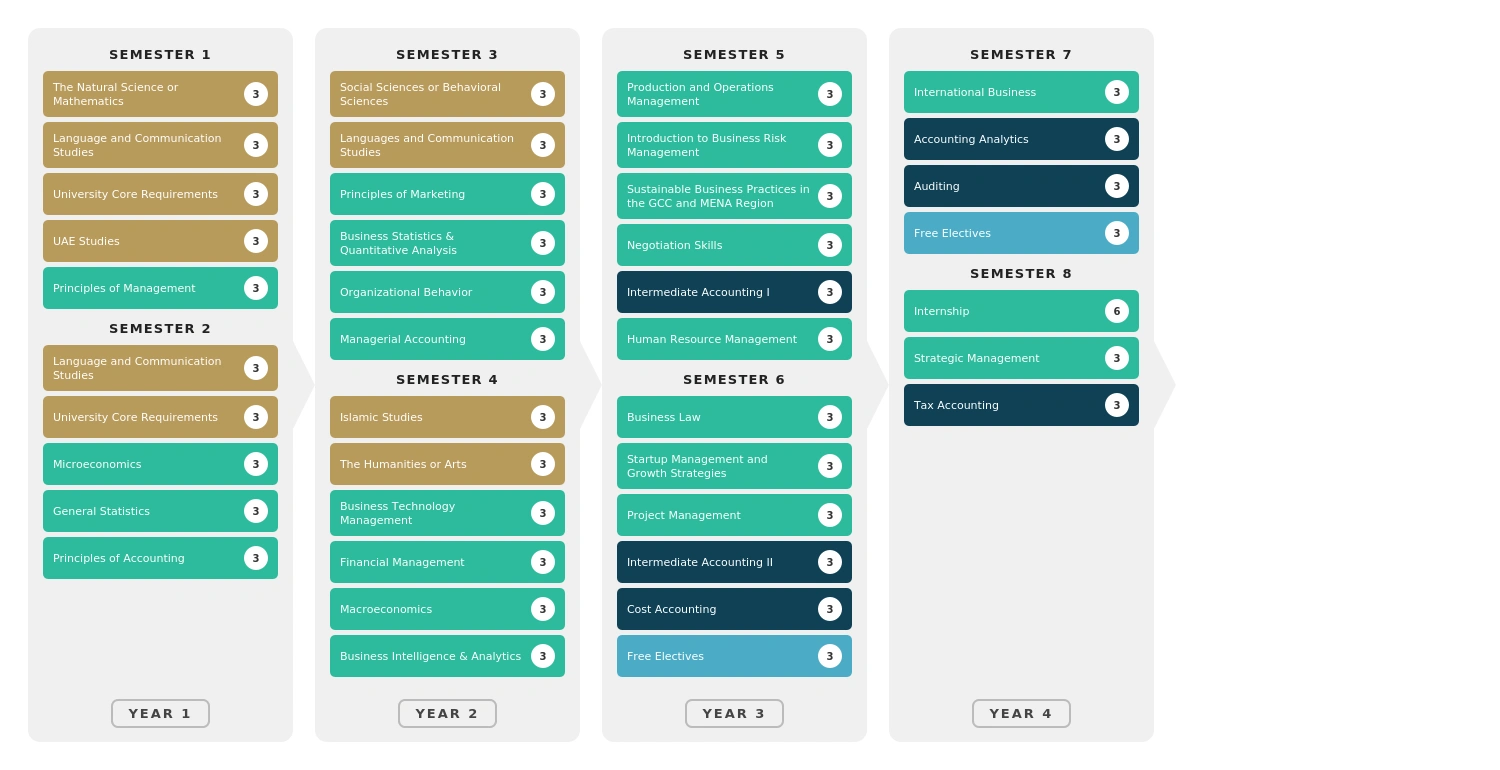
| Semester | Course | Cr. Hrs |
|---|---|---|
| Semester 1 | The Natural Sciences or Mathematics | 3 |
| Semester 1 | Language and Communication Studies | 3 |
| Semester 1 | University Core Requirements | 3 |
| Semester 1 | UAE Studies | 3 |
| Semester 1 | Principles of Management | 3 |
| Semester 2 | Language and Communication Studies | 3 |
| Semester 2 | University Core Requirements | 3 |
| Semester 2 | Microeconomics | 3 |
| Semester 2 | General Statistics | 3 |
| Semester 2 | Principles of Accounting | 3 |
| Semester | Course | Cr. Hrs |
|---|---|---|
| Semester 3 | Social Sciences or Behavioral Sciences | 3 |
| Semester 3 | Language and Communication Studies | 3 |
| Semester 3 | Principles of Marketing | 3 |
| Semester 3 | Business Statistics & Quantitative Analytics | 3 |
| Semester 3 | Organizational Behavior | 3 |
| Semester 3 | Managerial Accounting | 3 |
| Semester 4 | Islamic Studies | 3 |
| Semester 4 | The Humanities or Arts | 3 |
| Semester 4 | Business Technology Management | 3 |
| Semester 4 | Financial Management | 3 |
| Semester 4 | Macroeconomics | 3 |
| Semester 4 | Business Intelligence & Analytics | 3 |
| Semester | Course | Cr. Hrs |
|---|---|---|
| Semester 5 | Production and Operations Management | 3 |
| Semester 5 | Introduction to Business Risk Management | 3 |
| Semester 5 | Sustainable Business Practices in the GCC and MENA Region | 3 |
| Semester 5 | Negotiation Skills | 3 |
| Semester 5 | Human Resource Management | 3 |
| Semester 5 | Intermediate Accounting I | 3 |
| Semester 6 | Business Law | 3 |
| Semester 6 | Startup Management and Growth Strategies | 3 |
| Semester 6 | Project Management | 3 |
| Semester 6 | Intermediate Accounting II | 3 |
| Semester 6 | Cost Accounting | 3 |
| Semester 6 | Free Electives | 3 |
| Semester | Course | Cr. Hrs |
|---|---|---|
| Semester 7 | International Business | 3 |
| Semester 7 | Pre-Internship | 0 |
| Semester 7 | Accounting Analytics | 3 |
| Semester 7 | Auditing | 3 |
| Semester 7 | Free Electives | 3 |
| Semester 8 | Internship | 3 |
| Semester 8 | Strategic Management | 3 |
| Semester 8 | Tax Accounting | 3 |